Dîner de wine-dinners au restaurant de l’hôtel Bristol jeudi, 23 mars 2006

I arrive by the restaurant of hotel Bristol to open the bottles for a new dinner. The bottles have been delivered one week before and were put standing in the cellar yesterday morning by Jerome Moreau, the efficient sommelier of the place. Some material is waiting for me and I appreciate that, as it shows the commitment of the staff. Ludovic, a junior sommelier will help me and will smell rare scents. This ceremony of opening has become a tradition.

I am extremely disappointed by the three red Bordeaux, which seem tired, which should not be the case. Mission Haut-Brion 1964 is a solid wine. This one has an extraordinary fill in the neck. So, it should be good. I am ready to declare it dead. The Ausone 1953 looks tired, the Coutet 1952 (the Saint-Emilion) looks tired too, but I have more hopes. Added to that, the Sauternes 1943 seems to be weak. I am disappointed, and even more, for a specific reason.

A TV Channel, Monte Carlo TV, will make a subject on my cellar in a few weeks. So, I asked a friend who is a sommelier to make my cellar a little more glamorous, and he found some bottles whose future is compromised. Having hurt a Chateau Margaux whose year could be 1931, he suggested that I drink it rapidly, and two other Bordeaux were in a bad situation and needed to be drunk rapidly too.

If I had added the 3 wounded Bordeaux to sound bottles, it would be OK. But if I add them to wines counting some weak wines, things are not so good. As I had taken with me two spare bottles in case of emergency, I decided to open them. So, instead of having 10 bottles for 10 people, we will have 15 bottles, due to the addition of the 2 of the reserve and the 3 wounded added. We will see that many surprises occurred.

The guests of the dinner arrive precisely at 8 pm and I give the instructions or « rules » in order to enjoy the dinner, while we drink a champagne Charles Heidsieck 1982 that I have added. The colour of the wine is of an elegant peach light gold, the bubble is still lively, and the champagne is a good way to show what happens with old wines which have integrated all their flavours. The small “amuse-bouche” are very spicy, which seems to be a “façon” of the chef. They make appear various aspects of the champagne.

The menu has been composed by Eric Fréchon helped by Jérôme Moreau, and my comments, which were not numerous, have been taken into account.

Here is the menu :

Chamalot parmesan, beignets de lotte, cornets de foie gras aux anguilles, maquis

Bouillon cube de foie gras de canard, langoustines mi cuites au gingembre, coriandre et cébettes

Topinambour et truffes noires, cuites en croûte de foin, bouillon mousseux au jus de truffe

Filet de Sole farci aux girolles, sucs d’arête réduit à peine crémé

Pot au feu de cochon et bœuf, volaille au foie gras, os à moelle et céleri rave

Fourme d’Ambert

Poire caramélisée cuite à l’étouffée, jus aux zestes de clémentine semi confite, glace à la vanille

It was a truly comfortable menu as it was not too provocative, and was designed to help the old wines to shine.

In our group, three people had already attended a previous dinner. We had French, Belgian and Luxemburg people around the table. Many people from business and finance, and a man managing a group of restaurants.

There was a big contrast between the first champagne and the Laurent Perrier cuvee Grand Siècle from a recent release, with wines coming probably from the period 1995 to 1997. If the first was masculine, this one is outrageously feminine, seducing, with an immense power of evocation of white flowers as the ones which accompany the new design of Laurent Perrier. It has the charm of a sophisticated strip tease.

 The Gewurztraminer Gustave Lorentz réserve 1966 is one of the greatest surprises of this dinner. The nose was very generous by opening some hours ago, and when drinking it, it is really flashing. It is not a late harvest so some points of dryness are really exciting. It is enigmatic and very successful. On the soup, it shines marvellously. A great wine and a great combination. I heard many “oh” and “ah” as everyone was amazed by this level of quality of a perfectly kept wine.

The Jerusalem artichoke of Eric Fréchon is exceptional. I had said so many nice words on the rare Montrachet Comtes Lafon 1990 that when it appeared, all of us we were surprised. It is a great wine, with a light gold in colour, a nice smell, but it is as if a car was on the first gear and could not go to the second one. We can feel the promise of a great wine, but we have not the true Montrachet that we were expecting.

Eric Fréchon had thought of a provocative choice to associate the course with a white and a red. And I had said yes. So, La Mission Haut-Brion 1964 was served at the same time as the Montrachet. And the surprise came from this wine, which I would have declared dead, and which came back to life due to the oxygen. Of course it was not the most brilliant example of a Mission 1964, but it was really expressive. And the truffles doped it.  And as the Montrachet was playing under its category, it helped to make the Mission even more loveable.

On the sole, two wines. Objectively, it is the Château Coutet Saint-Emilion 1952 which is in the logic of the fish course. The wine has suffered. A little roasted, truffle like, it goes very well with the sauce. The Château Ausone 1953 starts slowly. Polite, it begins by being discrete. But when it is installed in the glass, we can see all the charm of this great wine. It is very intelligent, not invading, but sufficiently great to be appreciated by all.

On the “pot au feu”, we will have three Burgundies instead of two, as I had added the Corton.

The Chambolle Musigny les Amoureuses P. Misserey et Frère 1981 is extremely charming and performs largely better than what could be expected. Very young but altogether evolved, it is warmly sympathetic. The Le Corton Bouchard Père & Fils 1980 has a very clear message, as in a Chinese calligraphy. I love these Burgundies. And the Chambertin Charles Viénot 1934 is highly emotional. I had acquired this wine on the public sale of the cellar of Pierre Cardin in Maxim’s, and up to now, every try had been convincing. This wine is perfect. The structure is precise, dense, signalling a truly great wine. What is amazing is that critics could be made to the Bordeaux, even the most noble, and that no critic could be made to the three different Burgundies. This happens once, tonight, and cannot be considered as general.

Then we tried the three added wounded wines. The Chateau Margaux 1931 has been bottled by a merchant some decades ago and has no year on the label. As I wanted to know, we drank it with experts some years ago, and the central idea was 1931. A weak year, but a pleasant wine. And this one, just wounded by a manipulation of my friend was spectacularly good. So, this addition could sweep all the interrogations on the previous Bordeaux. We enjoyed a truly great Margaux.

The two others had not the same presentation. The Lynch-Moussa 1953 was undrinkable, and the Château Trottevieille 1967 could have been tried, but there was no need to insist, so I rejected it.

The Haut Sauternes Guillaume 1943 has a nice colour of a Sauternes of this period. The smell had been discrete and remained in the same stage. But the fourme d’Ambert helped it to appear a little intelligent. It was pleasant for a while.

Now, it is possible to forget anything as the Chateau d’Yquem 1936 is absolutely exceptional. I had already drunk this year, but this bottle is above any of my expectations, and by far. I consider generally that the decade 30ies gave, with the exception of 1937 wines with a low botrytis. But this one is against my analysis. This Yquem is a Yquem full of joy, with fantastic expression of fruits with an orange colour : apricot, mango, some sorts of prunes, yellow peaches, and it is wonderful. It is this type of Yquem that I love, and tonight I loved it more than the last 1937 that I have drunk.

The pear of Eric is very tasty, but does not add anything to this shining Yquem which needs to be drunk alone.

We have voted as it is traditional.

The Yquem won 7 votes as first, the Chambertin 1934 got one vote as first, as is the case for the Laurent-Perrier and the Gewurztraminer.

The consensus of the votes was in favour of Yquem 1936, Chambertin 1934, Gewurztraminer 1966 and Ausone 1953.

My personal vote has been :

Roman">-Roman"">          Yquem 1936

Roman">-Roman"">          Chambertin 1934

Roman">-Roman"">          Gewurztraminer 1966

Roman">-Roman"">          Ausone 1953

The bad surprises were the Mission 1964 with a super high fill and the Montrachet Comtes Lafon 1990 for which I do not understand the underperformance.

It appears that the bad performing were not the oldest ones, which gained the best votes.

But it shows that wine collecting is not a quiet hobby.

And it shows too that the oxygenation helped a lot to make some wines better than they would have been with another method. The Coutet 1952 and the Margaux 1931 have benefited from the oxygen.

Eric Fréchon has made a very intelligent cook as he acted to enlarge the quality of the wines. The service has been perfect.

Despite the dissatisfaction that some of my “children” did not perform as I would have liked, this was a great dinner, with, once again, a wonderful and impressive Yquem.

The greatest Yquem of the 20th century lundi, 20 mars 2006

I was asked on the Mark Squires forum which years are the best for the 20th century. Here is my answer :

Here are the Yquem that I have drunk for the last six years, since I take notes on what I drink.

Roman">1861 - 1876 - 1893 - 1893 - 1900 - 1906 - 1908 - 1908 - 1917 - 1921 – 1921 - 1921 - 1928 - 1928 - 1929 - 1931 - 1932 - 1933 - 1934 - 1936 - 1937 – 1937 - 1937 - 1937 - 1940 - 1941 - 1942 - 1942 - 1945 - 1947 - 1948 - 1949 – 1949 - 1950 - 1955 - 1955 - 1959 - 1959 - 1959 - 1960 - 1961 - 1962 - 1966 – 1967 - 1967 - 1967 - 1967 - 1967 - 1973 - 1975 - 1976 - 1978 - 1979 - 1980 – 1981 - 1982 - 1982 - 1983 - 1983 - 1983 - 1984 - 1986 - 1986 - 1987 - 1987 – 1988 - 1988 - 1988 - 1988 - 1988 - 1988 - 1989 - 1989 – 1989 - 1990 - 1990 - 1990 – 1990 - 1991 - 1991 - 1991 - 1994 - 1995 - 1995 - 1995 - 1996 - 1996 - 1996 – 1997 - 1998 - 1998 - 1998 - 1999 - 1999 – 2001 - 2001


What is difficult is that I never compare Yquems, as I never open two together, or if I do so, there is a young and an old.
And I must say too that when I drink Yquem, I enjoy it so much that every Yquem is my best Yquem.

As I like old Yquem, my answer will be :
1 - 1900
2 - 1928
3 - 1947
4 - 1959
5 - 1955

But I must say that I am not sure of my answer, as some 1929, a 1908 and a 1917 have pleased me enormously.

On Thursday, I will open a Yquem 1936 of a very high fill and of a magnificent colour (original fill). Normally it should be a great one as I prefer the taste of Yquems with orange colours to caramail colours.

Les prix des vins s’envolent dimanche, 19 mars 2006

voici un article du Monde :

LE MONDE | 18.03.06 | 13h20 • Mis à jour le 18.03.06 | 14h50

Après plusieurs années marquées par la morosité, le marché des enchères de vins s'est repris en 2005 avec quelques belles ventes au cours du second semestre sur des premiers crus classés de bordeaux ou des grands bourgognes. Selon le courtier en ventes aux enchères et en ventes en ligne de vins Idealwine, le retour des investisseurs étrangers, qu'ils soient américains, russes ou asiatiques, sur le marché français et le regain d'intérêt pour des crus plus mûrs ont permis au marché de se reprendre. "Les nouveaux acheteurs sont très exigeants et se constituent de très belles caves, déclare Pascal Kuzniewski, expert en vins. Cela correspond à la fois à un art de vivre et à un outil de diversification du patrimoine. Ce type d'investissement est directement lié aux marchés financiers."

Après une campagne primeurs 2004 sans grand relief et une offre pléthorique, les amateurs de vins ont préféré limiter leurs achats sur ce segment pour réallouer des fonds vers des crus plus mûrs. Ils ont également profité d'offres massives de déstockage proposées sur des vins récents, y compris sur certains grands bordeaux 2000 en début d'année. Une bonne affaire, car les prix sont repartis à la hausse : un Latour 2000, adjugé 318 euros en avril 2005 à Toulouse, était coté 382 euros en fin d'année. Sur les huit derniers millésimes commercialisés en primeurs, le bordeaux de 2000 est actuellement le seul à avoir enregistré une plus-value annuelle de plus de 5 %. Le Château Léoville Las Cases figure parmi les vins les plus recherchés.

Les millésimes des années 1980 et 1990 se sont échangés à des niveaux élevés. "L'année 1982 reste la valeur de placement par excellence", souligne Pascal Kuzniewski. Un Latour 1982 a atteint ainsi 708 euros à Paris en novembre 2005, soit 64 % de plus que sa cote habituelle au moment de la vente. "Les caisses complètes de bordeaux 1982 devenant rarissimes, on devrait voir les prix continuer à grimper en 2006", ajoute-t-il. Le fait est : jeudi 16 mars, un Petrus 1982 coté 1 580 euros a atteint 3 749 euros et un Cheval-Blanc 1982, estimé 520 euros, s'est vendu 1 310 euros, lors d'une vente organisée à Paris chez Tajan.

Les vieux millésimes séduisent de plus en plus d'amateurs et de professionnels. Après les bourgognes et les liquoreux de Sauternes, le phénomène atteint maintenant les bordeaux anciens. Un Lafite- Rothschild 1898 s'est ainsi vendu 847 euros en juin 2005 et un Haut-Brion 1926 a été adjugé 1 592 euros quatre mois plus tard.

Difficile de parler de bordeaux sans citer Petrus, dont le cru reste mondialement recherché quel que soit son millésime. "Un Petrus 1975, coté habituellement 760 euros, a atteint 1 028 euros en octobre 2005 à Paris", rappelle Angélique de Lencquesaing, associée fondateur d'Idealwine. En 2006, il faudra suivre de près les cours de Haut-Brion après les fortes hausses enregistrées l'an dernier et un millésime 2005 annoncé comme particulièrement réussi."

LES GRANDS FORMATS TRÈS RECHERCHÉS

Toujours en bordeaux, on retiendra la vente chez Tajan à Paris, en octobre 2005, d'une caisse "Carré d'as" 2000 (Petrus, Margaux, Latour et Haut-Brion). Les grands formats restent très prisés. De la bouteille à l'impériale en passant par les doubles magnums et les jéroboams, les tarifs se sont envolés fin 2005 : un jéroboam de Château Mouton-Rothschild 1982 s'est vendu 6 133 euros à Montauban (Tarn-et-Garonne) en décembre 2005 et un Château Margaux 1990 en impériale 7 198 euros. A long terme, la plus-value enregistrée sur un magnum creuse l'écart avec le prix de deux bouteilles.

Les grands bourgognes, et en particulier le domaine de la Romanée-Conti, ont terminé l'année sur quelques ventes spectaculaires. Ainsi, un flacon de Romanée-Conti de 1945 a obtenu 15 214 euros à Louviers (Eure) fin 2005. "Les résultats, nombreux, ont permis d'établir une cotation en Europe et aux Etats-Unis, et en font une valeur de placement facile à suivre. Donc un cru éligible à l'investissement", précise Mme de Lencquesaing. Parmi les autres domaines très spéculatifs figurent Dugat-Py, notamment avec le Chambertin 2003 (1 229 euros à Cannes en décembre 2005), ainsi que les domaines de Vogüé, Leroy et Jayer. En bourgognes blancs, la tendance est toujours à la hausse autour des domaines de la Romanée-Conti, de Coche-Dury, des Comtes Lafon...

Reste le champagne, qui enregistre à nouveau une année record avec les millésimes de collection. Un Cristal Roederer 1990 en mathusalem a été adjugé 13 327 euros à Toulouse, en décembre 2005. C'était une cuvée spéciale "2 000 flacons pour l'an 2000".

Martine Picouët

Article paru dans l'édition du 19.03.06

dîner de wine-dinners au Chateau d’Yquem jeudi, 9 mars 2006

I arrive before 4 pm in the castle of Yquem. For the last two days the bottles were standing on a table in the circular room of one of the towers. A photograph will take pictures of the whole event.

Christiane prepares the table, and 12 glasses are strictly arranged in front of every seat. Nice white flowers are presented in every possible place. All is nice. The whole place smells wax as every room had been cleaned and waxed. I ask that every window would be opened to rub this awful smell.

I open the bottles, and Sandrine Garbay, whose husband had an operation in a clinic, was not there, but Valerie Lailheugue looked with a great attention to my operations. Every smell is very classical. The smell of the Carbonnieux 1928 is so generous that I decide to close it with a neutral cork. The Corton 1929 is a little disturbing but will be cured by the air. The Chateau Chalon 1955 instead of having a smell of nuts has a smell of truffle. We will see.

Now my emotion is at its maximum. I will open the Yquem 1861. Here is what is included in the book of Yquem written in 1986 by Richard Olney : “Yquem 1861 : totally incredible wine. One of the great wine experience of a lifetime… a nectar that should see the next century in fine shape. Dark brown colour, amber gold tones. Rich, intriguing nose. Rich, deep, liqueur-like texture… Very long finish. Perfect balance. Exquisite (The Underground Wineletter, 1983). Twice tasted by A. de Lur Saluces who was both times astounded by its vitality, depth and complexity. Picking began 24 September.”

The castle has still one 1861, but which was recorked. My bottle is original, and Sandrine Garbay, responsible of the cellar and of the wine making, had already confirmed that it is an original cork and confirmed again when she came later. So, for me, to open a liquid which had stayed in the same bottle for 145 years minus 3 of barrels is incredibly serious.

I put away a capsule of golden colour but which has some black stains. I try to clean the top of the bottle, and some pieces of glass fall. I separate some tiny pieces of glass. Why does the glass break so easily ? And I begin to panic. I ask for a hair dryer to put away any piece of glass, the wine being protected by the cork still inside. And I begin to pull the cork. It breaks as a flower which would lose its petals. I use a special corkscrew which allows me to feel what happens, and I succeed in pulling every piece outside the bottle with nothing falling in the wine.

I smell. And “wow”. Imagine the actor who listens that he has received the Oscar  award for the best actor. This smell gave the same message to me. Perfect.

The colour had made me fear that it would be caramelised. It was not! Less that the Yquem 1950 that I had four days ago. Fantastic. If Valerie had not been there, I would have danced alone in the room. I drank a sip and shared a drop with Valerie. Once again fantastic. I was so happy. As if my heavy weight had become a feather weight. Wow. The rest of the day would be relaxed. And in our mouth, the taste of the Yquem never ended.

Sandrine Garbay arrived, and I had kept the empty glass. The perfume that came from the glass had the real perfection of Yquem. I had such a joy. Sandrine seeing my excitement took a Yquem 1957 that was recently opened, and gave me one glass. A pure Yquem with no extravaganza, whose length was shortened by a few days of opening. But a delight. And I was happy.

I talked with the people who would serve the wines, I arranged every bottle for a proper temperature and position, and when I was sure that everything would be proper, I went to take a shower in a room of the castle. Under my shower, it was as if I were the king of the universe.

I wait for the guests in the office of Pierre Lurton, who is always between two trips, chatting with him.

The guests arrive, and we visit the chais, and we taste the Yquem 2001. This Yquem is immense. It is the definition of the perfection of Yquem. What a personality. It has already changed since the last time I drank it. The taste of grapes has evolved towards darker grapes. I love this wine.

We go to the castle. We are nine. Four couples and myself. We drink a Dom Pérignon 1985 which was designed to clear the mouth from the invading persistent charm of Yquem 2001. It is served with some cakes that I could not negotiate to avoid. These cakes shorten this elegant champagne which is a champagne of fight : it requires a complicated food to fight with it for the pleasure of our palate. Obviously a great champagne.

We go to our table nicely dressed in an emotional room. The menu of the chef Marc Demund is : Œuf Poché au Corail d’Oursins / Noix de st Jacques sur Effilures d’Echalotes Confites / Homard Rôti aux Truffes / Esturgeon et Poireaux Bordelaise / Mignon de Veau à la Fleur de Lavande / Foie Gras de Canard Poêlé aux Amandes / Comté / Pavé de Mangue et Agrumes / Mignardises.

I had talked a lot with Marc to make these choices.

We begin with Laville Haut-Brion 1976. Already golden colour, intense nose, this wine exposes what I announce concerning the world of old wines. Magnificently balanced, the wine is enlarged by the urchin.

The Chateau Carbonnieux white 1948 is an enigma. I had checked that it is an original bottling (this can be done by looking, under the capsule, the sediment), and it amazes everyone that the wine is incredibly young. The yellow colour is almost as green as for a young wine, the smell is of an infant, and the taste is brilliant because then we see that age has integrated every aspect. With the scallop, a classical combination.

The lobster will welcome two wines : Pavie 1971 and Carbonnieux red 1928. My palate is used to such old wines which appear as heavy as Port wines. This Carbonnieux is truly heavy like lead, having an unbelievable concentration. I love a lot. My guests less. The length is incredible. If they do not try so much the Carbonnieux, it is because the Pavie is to adore. I will not raise any controversy, but I adore this Pavie, elegant and expressive, for my taste largely above any recent version of the same wine. And with the Audouze method, the two wines shine at their best. The combination with a lobster a little too cooked is a delight. The heavy truffled sauce taken with the Carbonnieux which smells truffles is a unique moment. Probably the best match for me.

The smell of the Chambolle Musigny Bouchard Père & Fils 1967 is, after the great old Yquem the smell of the evening. Emotional, seducing. I love it. And in mouth with the sturgeon, it is fantastic. This wine is absolutely performing above its category. And the Echézeaux Domaine de la Romanée Conti 1991 is magnificent too, even if more accessible for everyone due to its age. I have loved it. I was a little afraid of a possible repulsion of the bordelaise sauce with the wines. It was a success, and it is my coquetry to have put a bordelaise sauce with two Burgundies in Chateau d’Yquem.

The veal was delicious and the Corton« cuvée B » Brossault 1929 whose smell was unpleasant had gently become to the state I expected. A delicious Corton of the greatest year for Burgundies. Light colour with some pink. Smell rather short. And a fill in mouth of warm welcome, complex taste, pleasure. I have drunk better 1929, but this one was nice too.

I had asked that the foie gras would come at the end, as it was made in the 19th century. The Krug 1988 was not the proper match with it. A gently light sweet wine would have been more logical.

A delicious Comté not too old as I had asked made shine a Chateau Chalon Jean Bourdy 1955 which was rather light for a “vin jaune”, which was particularly good, as a stronger wine would have disturbed some of my guests, specially the women.

Not knowing that the 1861 would be so good, I had planned that we would finish with the Yquem 1961 to keep a nice taste in mouth. But as it was so great, we would finish naturally with the older.

Yquem 1961 is a great Yquem. It is the gift of Pierre Lurton for this dinner, with the intention to see what a century of distance will make. Directly in the historical line of Yquem, with a great power, a balanced structure, a very deep trace in mouth made by fruits like peaches, apricots. Great, and historically designed. If I want to be indelicate, I would say that it is the first time in this historical room that I have tasted such a perfect match of a dessert with a Yquem. I know that it is naughty from me.

We were expecting the star : Yquem 1861. The nose is spicy, prunes, intense, and curiously, with no default. In the glass the colour is very brown, but when the wine is moved, the gold shines more. In mouth it is religious. The definition of the structure is so precise, delicate. It evokes candied prunes, or prunes burnt by the sun, or marmalade of prunes. The citrus fruit aspects are very discrete but exist to make it more charming, and the caramel, torrified aspects, are discrete too. You can think of coffee, tea, but the main image is prunes. And what is impressive is the incredible length.

Normally in the castle some alcohols like Paradise Hennessy are served. Everyone did not touch any, just to keep the perfection of this rare Yquem in mouth.

The atmosphere was not to make people vote. But I give my ranking : Yquem 1861, Chambolle Musigny Bouchard 1967, Carbonnieux blanc 1948 and Château Pavie 1971. The Yquem 1961 would be highly ranked in another dinner, but tonight it is in the shadow of the 1861.

I could say that for a collector as I am, to present my wines in a dinner by Château d’Yquem represents what could make me think : now, I can die in peace. Many events to come should give me the motivation to continue these adventures.

dîner de wine-dinners au Chateau d’Yquem jeudi, 9 mars 2006

  1. Champagne Dom Pérignon 1985
  2. Château Laville Haut-Brion blanc 1976
  3. Château Carbonnieux blanc 1948
    j'aimerais conserver toutes ces capsules aux couleurs d'une rare beauté
  4. Château Pavie 1971
  5. Château Carbonnieux 1928
  6. Chambolle Musigny Bouchard 1967
  7. Echézeaux Domaine de la Romanée Conti 1991
  8. Corton « cuvée B » Brossault 1929
  9. Champagne Krug 1988
  10. Château Chalon Jean Bourdy 1955
  11. Chateau d'Yquem 1961
  12. Chateau d'Yquem 1861

le menu composé par Marc Demund :

Œuf Poché au Corail d’Oursins

Noix de st Jacques sur Effilures d’Echalotes Confites

Homard Rôti aux Truffes

Esturgeon et Poireaux Bordelaise

Mignon de Veau à la Fleur de Lavande

Foie Gras de Canard Poêlé aux Amandes

Comté

Pavé de Mangue et Agrumes

Mignardises

67ème dîner de wine-dinners au Chateau d’Yquem – le récit jeudi, 9 mars 2006

J’avais apporté il y a deux jours les bouteilles du 67ème dîner de wine-dinners au château d’Yquem. J’arrive le jour « J » un peu avant 16 heures, les sourires sont sur toutes les lèvres. Sandrine Garbay ne sera pas là quand j’ouvre les bouteilles mais nous les commenterons longuement lorsqu’elle me rejoindra. Un photographe m’accompagne pour immortaliser l’ouverture des vins que Valérie observe avec grand intérêt, et Christiane, gardienne attentive de ce beau patrimoine observe ces allées et venues avec des yeux miroitant d’envie gourmande. Le Carbonnieux blanc 1948 paraissant tellement plus jeune que le Laville Haut-Brion 1976, j’observe le dessous de la capsule et le bouchon qui confirment bien que la bouteille est d’origine. Sa conservation est magnifique. L’odeur du Carbonnieux rouge 1928 est si capiteuse que je rebouche avec un bouchon neutre. Les émanations du Corton 1929 me font un peu peur, mais cela va sans doute se corriger, et le Château Chalon 1955 m’étonne. Là où j’attendais de la noix, c’est la truffe qu’exhale ce vin jaune. Arrive enfin le grand moment. Le Château d’Yquem 1861 très foncé sera-t-il caramélisé ou aura-t-il la chatoyante perfection d’Yquem ? C’est maintenant que je le saurai. La capsule est noircie et collante. J’enfonce une mèche dans le bouchon. Je soulève, et voici que le verre s’effrite. J’enlève quelques éclats, je nettoie alors que le bouchon est à peine soulevé, et j’utilise un sèche-cheveux pour qu’aucune poussière de verre ne puisse subsister. Le bouchon se brise en mille morceaux comme une fleur qui perdrait ses pétales. Aucune parcelle ne tombera dans la bouteille. Et là, bingo, jackpot, le parfum de ce vin est extraordinaire. Le caramel est infime, alors que le cassis, le poivre que j’avais sentis dans des 2005, les fruits confits, lancent des milliers de signes de vie. Je goûte et c’est l’extase. Il s’agit d’un immense Yquem. Valérie avait imprimé une fiche de dégustation du livre sur Yquem dont voici le texte : « " vin incroyable. Sa dégustation est un sommet d'expérience dans la vie d’un œnophile...un nectar qui verra le siècle à venir en parfait état. Acajou aux reflets dorés. Nez riche, fascinant; texture de liqueur. Très longue suite. Equilibre parfait. Exquis." (The Underground Wine Letter, 1983). Goûté à deux reprises par Alexandre de Lur Saluces, qui à chaque fois fut étonné par sa vitalité, sa profondeur et sa complexité. Vendanges commencées le 24 septembre. ». Ce que je découvre est exactement ce qui fut écrit il y a 23 ans. Si vous voulez prendre conscience de l’état de ma joie à ce moment là, allez voir sur le blog la photo qui fut prise de ma jouissance intérieure.


La longueur de ce vin est infinie, et je sentirai des dizaines de fois le fond de ce premier verre. Il s’agit d’un vin issu d’une bouteille qui n’aura jamais été ouverte en 145 ans puisqu’elle est d’origine, ce qui lui confère une rareté encore plus grande. A partir de là ma vie devient plus belle. Sandrine Garbay qui nous rejoint sent les vins avec moi et nous les commentons. Une bouteille entamée d’Yquem 1957 trainant à portée de main, Sandrine m’en verse quelques gouttes pour apaiser mon émotion. Ouvert depuis plusieurs jours, il a perdu de sa longueur, mais Yquem reste Yquem. En prenant ma douche dans une chambre mise à ma disposition, j’ai les mêmes sensations qu’un acteur à qui l’on aurait annoncé qu’il recevra l’Oscar du meilleur acteur. Sur un nuage, je vis un moment d’une intensité suprême. Je me dis que ma vie de collectionneur pourrait s’arrêter là. Mais attendons au moins le dîner.


Les invités arrivent et sont accueillis par Pierre Lurton qui nous fait visiter les chais. Les 2005 et 2004 sont en formation et les 2003 viennent d’être embouteillés. Dans la salle de dégustation nous goûtons Yquem 2001. Quel diabolique Yquem qui a tout pour lui, insolent gamin promis aux plus belles destinées. En le buvant, on « croque » le plus beau botrytis qui ait été fait.


Nous entrons au château et je vais rapidement saluer Marc Demund avec lequel j’ai eu de longues conversations de mise au point du menu. Dans le beau salon, le Dom Pérignon 1985 a pour mission d’effacer les traces indélébiles d’Yquem 2001. Mais au-delà de cela, il cause ! Champagne étonnamment complexe, aux mille évocations, il aurait besoin d’un beau plat, alors que les sacrosaints biscuits d’apéritif, dont je n’ai pas pu négocier l’absence, tradition oblige, brident sa longueur et son enthousiasme.


Nous nous rendons dans la merveilleuse salle à manger du château où nous serons neuf. Pierre Lurton et Carole, qui avaient déjà participé à l’un de mes dîners, deux relations qui m’avaient connu par France Info, un couple de russes et un couple d’ukrainiens. La connaissance des vins est loin d’être homogène, mais il y a de solides palais et une volonté commune d’apprendre.


N’ayant connu la cuisine de Marc Demund qu’en invité des lieux, je n’avais pas une vision exhaustive de sa cuisine. Son menu fut élégant, avec quelques audaces qui furent plébiscitées, et le tout d’un agrément certain : Œuf Poché au Corail d’Oursins / Noix de st Jacques sur Effilures d’Echalotes Confites / Homard Rôti aux Truffes / Esturgeon et Poireaux Bordelaise / Mignon de Veau à la Fleur de Lavande / Foie Gras de Canard Poêlé aux Amandes / Comté / Pavé de Mangue et Agrumes / Mignardises. Beau voyage bordelais.


Le Laville Haut-Brion 1976 a une couleur dorée. Son nez est expressif, et en bouche la qualité des plus grands blancs de Bordeaux apparait. Rond, à maturité, intégré et de belle longueur, il se marie à l’oursin de jolie façon. Pour ma jolie voisine, c’est le vin le plus ancien de sa vie, ce qui annonce bien des surprises à venir. J’ai senti qu’elle apprécie et apprend avec entrain. Le Château Carbonnieux blanc 1948 surprend toute la table par sa couleur de vin jeune. Le nez est de la même eau : éblouissant de jeunesse. C’est en bouche que l’on comprend qu’une palette de saveurs aussi bien constituée ne peut venir que d’un grand vin ancien. Je n’ai pas osé les échalotes, il parait que ce fut bon. La chair de la Saint-Jacques suffisait à mon bonheur.


J’ai fait cohabiter le Château Pavie 1971 et le Château Carbonnieux 1928 sur le homard, choix que j’adore. La truffe va remarquablement avec le Carbonnieux 1928 lourd comme du plomb, au nez de truffe. Tel un vieux porto il envahit le palais. Capiteux, il déroute quelques convives alors que je profite de chaque goutte d’un immense vin. A coté de lui, le Pavie d’une jeunesse folle (par comparaison), dandy chantant, se joue avec bonheur de toutes les composantes du plat. La chair du homard lui va bien. Beau Pavie très long, strict comme un Pomerol, et touché par la grâce d’une année qui réussit à la rive droite. Pierre Lurton apprécie en connaisseur l’élégance de ce saint-émilion, sans doute plus délicat que les réalisations actuelles de ce grand château.


Le Chambolle Musigny Bouchard Père & Fils 1967 offre la plus belle senteur de la soirée si l’on excepte Yquem. Magnifique odeur complexe et chaleureuse. Comme pour chaque vin, je suis émerveillé de ce qu’ils expriment lorsqu’ils ont eu l’oxygène qui leur convient. Que de fois dans d’autres dîners, on s’aperçoit à regret que c’est la dernière gorgée qui est la plus belle. Là, le vin est chaleureux dès son apparition. Et ce Chambolle Musigny est magnifique de charme et de gentille complexité. Il ne s’en laisse pas compter par l’Echézeaux Domaine de la Romanée Conti 1991, car celui-ci joue sur d’autres registres. Redoutablement séducteur comme les vins de ce domaine, il trouve dans la sauce de l’esturgeon un tremplin de pur bonheur. Quel accord splendide ! Marier une Bordelaise à deux vins de Bourgogne est un de mes plaisirs mutins, surtout lorsqu’on le fait dans ce site symbolique de la magie du bordelais. Deux bourgognes magnifiques qui forment un agréable pendant à la paire de bordeaux, quatre expressions du rouge dans des états d’un grand épanouissement.


Le délicieux mignon de veau accueille le Corton « cuvée B » Brossault 1929 dont l’odeur m’avait fait peur à l’ouverture. Il reste des soupçons d’âge, mais à mon agréable surprise tout le monde adhère à ce vin délicat, clair comme les Corton peuvent l’être. Sa longueur est belle, son palais fort subtil démontrant, s’il en était besoin, que 1929 restera dans l’histoire du vin. La Bourgogne dans sa majesté.


J’ai changé l’ordre des vins et des plats du fait de la dégustation d’Yquem 2001 qui demandait un traitement spécial du palais. Le foie gras se trouve donc ici, comme on le faisait au 19ème siècle, et j’ai gardé le champagne Krug 1988 sur ce plat. C’est une erreur que j’assume. Bien sûr, c’est possible. Mais ça n’apporte rien. Le champagne est grand, le foie gras est bon, aucun des deux ne se parle vraiment.


Un comté très approprié, car je l’avais demandé peu âgé, met remarquablement en valeur le Château Chalon Jean Bourdy 1955 qui a effacé mes craintes. Ayant un type « vin jaune » moins prononcé qu’à l’accoutumée, cela convient parfaitement à des convives novices qui n’eurent pas le réflexe fréquent de l’incompréhension. L’accord glisse avec facilité. Tout s’enchaîne avec bonheur.


Le Château d’Yquem 1961, offert par Pierre Lurton, pour servir de témoin à son aîné d’un siècle est un Yquem dans la ligne historique. La couleur est d’un or pur, joliment miellé, le nez est intense, d’un beau botrytis qui n’en impose pas. Et en bouche, c’est la récompense d’un Yquem sage, chaud, quasiment parfait. Le dessert lui va comme un gant, ce qui est sans doute l’un des plus beaux desserts que j’aie goûté en ce lieu que je révère, et va nous préparer à accueillir le vin qui justifie que l’on tînt ici ce dîner.


Le Château d'Yquem 1861 est d’une couleur foncée, lourde, mais lorsque le liquide s’écoule, des lueurs d’or et d’orange passent fugacement. Cette couleur est infiniment plus belle que celle qu’on apercevait à travers une bouteille opacifiée par l’âge. Le nez est éblouissant, sans doute plus pour moi que pour les autres convives, non parce que je serais celui qui « sait » mais parce que ma route a été jalonnée de témoignages de grands anciens. Pour Pierre, c’est son premier Yquem du 19ème siècle. Pour moi c’est mon plus ancien, car j’ai toujours raté les wagons qu’il eût fallu prendre où l’on ouvrait les 1847 et 1811, années qui me fascinent.


En bouche, c’est un nirvana absolu, car mieux que pour le 1950 récent, ce 1861 a dompté son côté caramel pour ouvrir ses bras aux fruits confits, aux compotes de pruneaux, et de temps en temps aux fruits oranges et aux agrumes. On ne peut pas boire cet Yquem sans émotion et sans penser qu’il a traversé 145 ans pour être bu. La date est historique pour nos hôtes russes, ce qui a justifié leur inscription à ce dîner. Je suis comblé par la perfection de ce nectar dont la longueur est telle que pendant la nuit et le lendemain matin, sa trace ne me quitta pas. Il faut évidemment des références pour goûter ce vin extrême. Mais les « novices » aussi sont touchés par sa majestueuse grandeur.


Pour la première fois je n’ai pas fait voter pour les vins, parce que l’atmosphère ne s’y prêtait pas. Je vais donc remplir l’unique bulletin de vote en commençant par Yquem 1861, suivi de Chambolle Musigny Bouchard 1967, Carbonnieux blanc 1948 et Château Pavie 1971. Il est certain qu’Yquem 1961 mériterait la vedette dans d’autres dîners. L’honneur qu’il porte à son aîné est magistralement mérité.


Ce soir fut la récompense la plus inespérée de ma passion des vins anciens. Merci à ceux qui l’ont permis.

je prépare un dîner avec des amis américains samedi, 25 février 2006

Last year I made a trip to Bordeaux with American people and we had magnificent moments during this trip.
I met an American man travelling with his son who had said before the trip that he would be happy to attend one of my dinners.
I prepared a dinner specially for him and his son (with other guests of course), and he announced : "I will bring a magnum of Haut-Brion white 1949". This was so generous that I decided to add to the dinner one of my Cyprus 1845 that I love so much.
The dinner was excellent.

This American friend announced recently : I would like to attend another dinner with my son.
So, I considered that this should be a dinner not within my structure but a familial dinner, and I said : I invite you and your sons (2) at home with my children too.
And he announced that he would come with a magnum of Krug 1976, and with two Laville Haut-Brion white 1947.
So, I told him that I would have to see in my cellar what could be opened on that day.

I have already told that one of the greatest moments for me is when I choose the wines, as I try to figure how my guests will enjoy the dinner.
And I try to do it by instinct.
In this case, I thought of the children. I would be happy if they remember this dinner for their entire life.
I should say that I have asked my friend who cooks so well to make the dinner at my home.

I chose first a Chateau Chalon Clos des Logaudes 1864. This is my oldest Jura wine, and I had decided that I would open it this year. This is a marvellous opportunity to do it.

Then I chose a Vouvray d'origine 1929, an enigmatic taste for a 1929 as it hesitates between a dry wine and a sweet wine. It is something unbelievable. No producer, no label, but a fantastic wine. The name is printed by burning letters on individual wood boxes.

Then I chose a Gewurztraminer SGN Hugel 1934 as it is probably the best year ever in Alsace

Then I chose Pétrus 1971 as I consider that 1971 was a magic year for Pomerols.

Now it was time to choose a sweet wine. I have such a nice memory of Filhot 1929 which was spectacular, so I chose this wine.

So, the provisory program for this dinner is :

- Magnum Krug 1976
-Roman"> Vouvray d’origine 1929

-Roman"> 2 Laville Haut-Brion white 1947

-Roman"> Pétrus 1971

-Roman"> Gewurztraminer Sélection de Grains Nobles Hugel 1934

-Roman"> Château Chalon Clos des Logaudes 1864

-Roman"> Château Filhot 1929

Normally one or two wines should be added in the reds category. We will see.
This should be a nice dinner (on April 22nd at my home, the day before my birthday).

Choosing the wines is one of my greatest pleasures.

dîner de famille dimanche, 12 février 2006

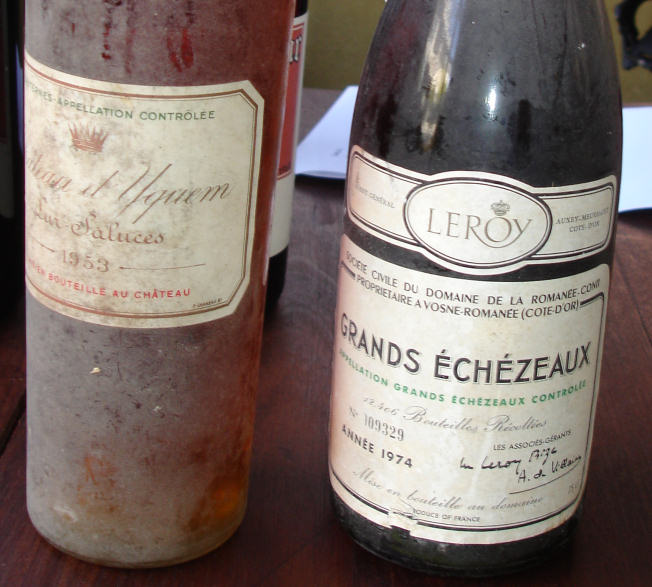
Mon fils appelle sa mère : nous venons ce soir. Il est 17 heures, des achats s’imposent. Je fais des courses, mon fils aussi, la nourriture s’amoncèle dans la cuisine. Je vais choisir en cave deux vins. Il ne faut pas réfléchir, juste se demander : est-ce justifié ? Le Bâtard-Montrachet Chanson Père & Fils 1959 a une couleur prometteuse. Je le prends en main. J’hésite plus sur le rouge. Mais un signal d’amitié et d’émotion pour mon ami Bernard Hervet, directeur général de Bouchard parait évident. Ce sera Grands Echézeaux Bouchard Père & Fils 1954.

A l’ouverture le Bâtard est capiteux, profond, un parfum. Le Grands Echézeaux est presque plus capiteux ce qui parait invraisemblable : quel tir groupé irréel. Tout cela promet.

Sur une andouillette de Guémené, le Bâtard-Montrachet Chanson Père & Fils 1959 est joyeux. Ce vin extrêmement puissant a une longueur en bouche inimaginable. Il est rond, chaud, emplit la bouche généreusement. Il y a bien sûr quelques petites traces de fatigue mais qui s’en soucie. Le message généreux et la longueur altière nous ravissent.

Sur une épaule d’agneau, le nez du Grands Echézeaux Bouchard Père & Fils 1954 annonce instantanément ce que le vin sera. Mon fils dit : « ça, c’est grand, c’est même très grand ». Je retrouve avec plaisir des similitudes avec le Grands Echézeaux du Domaine de la Romanée Conti 1942 bu il y a peu. Le DRC est plus racé, et le Bouchard est plus jeune. Pour plaisanter j’ai dit à mon fils : on dirait un 1999. C’est faux bien sûr mais c’est pour imager cette rare fraîcheur. Il y a toute la complexité bourguignonne et un goût de sel. Terre et sel, joli symbole. Ma bru qui n’est pas une adoratrice des vins anciens l’apprécia. C’est un signe. En le buvant je pensais à la maladie de notre époque d’organiser en permanence des dégustations verticales où l’on aligne le plus grand nombre de millésimes d’un même vin. Ce 1954 serait peut-être ignoré dans une dégustation verticale car on subirait l’influence de l’image qu’a laissée cette année. Mais ici, ce vin brille, tout heureux d’être aussi fringant. Désacraliser les hiérarchies, c’est un peu ce que j’aime faire.

académie du 26 janvier – les vins jeudi, 26 janvier 2006

 
les vins de l'académie, avec un "léger" effet miroir
Dernière nouvelle : l’Assemblée Nationale est en train de discuter d’un projet de loi visant à souligner, au nom de la République, le « rôle positif » qu’aura joué l’académie des vins anciens, lors de sa séance du 26 janvier, pour la compréhension du goût des vins anciens. Roman;">Nous étions 52 académiciens, forts de 47 vins à partager, apportés par de très nombreux présents mais aussi par des sympathisants qui voulaient marquer leur engagement.