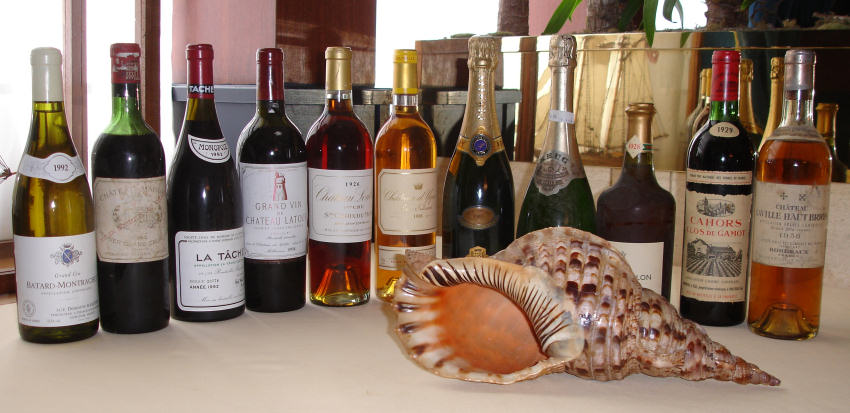
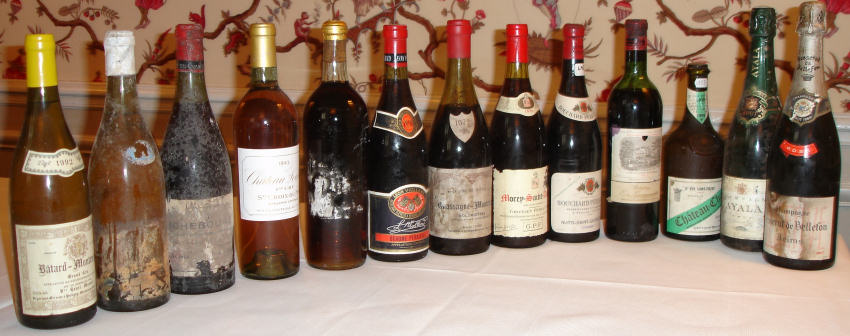
dîner de wine-dinners chez Gérard Besson mardi, 16 mai 2006

Dîner n° 76 – mardi 16 mai 2006

  1. Champagne Ayala très vieux, années 50
  2. Champagne Besserat de Bellefon rosé 1966
  3. Chablis Moutonne Grand Cru Long Dépaquit 1959
  4. Bâtard Montrachet veuve Moroni 1992
  5. Chassagne Montrachet rouge Boudriottes Marcel Toinet 1972
  6. Beaune Perrières Léon Villard 1950
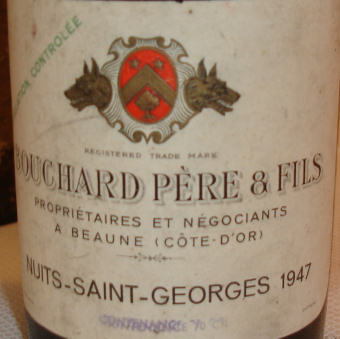
  7. Nuits Saint Georges Bouchard Père et fils 1947
  8. Richebourg Domaine de la Romanée Conti 1958
  9. Château Loubens Sainte Croix du Mont 1943
  10. Château Rayne-Vigneau Sauternes 1880 ? (le dernier chiffre sera lu sur le bouchon)

L'année du Rayne Vigneau est 1880.

J'ai ajouté

Château Chalon Le Puy Saint Pierre 1959 Vichot Girod

Château Lafite-Rothschild 1963

Le menu composé par Gérard Besson

Superposition de foie gras et aiguillette de bœuf truffée,

Brochette de ris de veau, truffe et Pompadour,

Huîtres juste pochées sur un tartare d'algues,

Filet de sole braisé au fumet de Saint Jacques,  infusion de homard bleu,

Une asperge, une morille,

Médaillon de langouste au macaroni fourré duxelles,

Rouget sauce rouget,

Carré de veau de lait d'Aurillac cuit rosé, jus et petits pois à la Française,

Cœur de côte de bœuf de Salers servi à point, ragoût d'artichaut vigneronne,

Noisette d'agneau du Limousin en chevreuil, navet et oignon fane en chapelure de pain d'épices,

Double Brie,

Composition d'agrumes "pomelos, clémentine", et inspiration du moment.

dîner de wine-dinners au restaurant Gérard Besson mardi, 16 mai 2006

J’aime faire des dîners avec Gérard Besson. Je me souviens être allé le même jour déjeuner chez Guy Savoy qui venait juste de décrocher sa troisième étoile, au sein d’une brigade en folie, pleine de sourires et de joie, et dîner chez Gérard Besson qui venait de perdre sa deuxième étoile. Cœur solide malgré la blessure, il a rajeuni la décoration de son restaurant mais gardé la finesse de sa cuisine. Paradoxalement, c’est la perte de cette étoile qui m’a attaché à lui, car je crois en son talent authentique. Nous en avons eu une démonstration exceptionnelle hier à l’occasion du 71ème dîner de wine-dinners. Car Gérard Besson, comme très peu de grands chefs, comprend les vins anciens. Il a donc adapté des recettes à leur seul profit. Et ce fut grand.

J’ouvre les bouteilles à 17 heures sans aucun problème pour celles de ma cave. Le bouchon d’une Lafite-Rothschild 1963 qui m’avait été offerte pour ce dîner tombe dans la bouteille, ce qui nous oblige à décanter. Il reste dans la bouteille un lourd dépôt. Le bouchon que nous extirperons avec Alain, sommelier de talent, est totalement imbibé.

Il y a autour de la table trois habitués, un couple d’alsaciens qui ont reçu ce dîner en cadeau, un couple de fidèles lecteurs de mes bulletins, le couple qui m’a aidé à créer le blog, et le rédacteur en chef de Bloomberg News à qui je dois un article élogieux dans sa revue mais aussi dans une revue américaine de forte diffusion. Au-delà des propos enjoués et décontractés, chacun se rend bien compte que nous vivons un moment intense de haute gastronomie où les accords sont ciselés au milligramme près. Car Gérard Besson a goûté tous les vins dans leur stade ultime d’épanouissement pour ajuster le poids de chaque sauce. Voici son menu :

Superposition de foie gras et aiguillette de bœuf truffée / Brochette de ris de veau, truffe et Pompadour / Huître juste pochée sur un tartare d'algues / Filet de sole braisé au fumet de Saint Jacques,  infusion de homard bleu / Une asperge, une morille / Médaillon de langouste au macaroni fourré duxelles / Rouget sauce rouget / Carré de veau de lait d'Aurillac cuit rosé, jus et petits pois à la Française / Cœur de côte de bœuf de Salers servi à point, ragoût d'artichaut vigneronne / Noisette d'agneau du Limousin en chevreuil, navet et oignon fane en chapelure de pain d'épices / Double Brie / Composition d'agrumes "pomelos, clémentine", et inspiration du moment. C’est impressionnant et particulièrement bien choisi.

Le Champagne Ayala que j’avais annoncé : très vieux, année 50 est plutôt un Champagne Ayala Brut # 1978. Car le bouchon indique un vin beaucoup plus jeune que les années 50. Il est étonnamment doux, sans grande longueur, mais joyeux en bouche, et c’est la truffe qui le rend agréable.

Le Champagne Besserat de Bellefon rosé 1966 me fait glousser de plaisir. Sa couleur de pêche jaune est joyeuse. Son nez est éblouissant, et en bouche, l’acidité qui forme l’ossature s’installe sur le centre de la langue et montre une noblesse rare. Coloré, remarquablement construit, ce champagne est un des plus grands rosés que j’aie jamais bus. Immense champagne qui joue avec le ris de veau, mais surtout les dés de champignons, un duo d’amour. Je me tortillais sur ma chaise comme le gamin qui n’en peut plus de joie.

Le Chablis Moutonne Grand Cru  1959 Long Dépaquit époustoufle le journaliste américain. C’est en effet un immense Chablis, au nez minéral et à la bouche de Meursault. Lourd, gras, il s’installe en bouche avec une insistance de bon aloi. L’huître n’est pas du tout adaptée à ce divin breuvage mais ce n’est pas grave, car on peut en jouir après avoir goûté le délicieux fruit de mer. Beau Chablis qui a intégré toute sa beauté, chantant, riche et réjouissant le palais.

Le Bâtard Montrachet 1992 Veuve Morini ramène sur des terres beaucoup plus connues. Puissant, évoquant pour certains des fleurs, alors que je pense à noix et amandes, ce vin est adapté à une sole particulièrement brillante. Mais le vin est plus simple que le Chablis complexe.

Il était évident que le Château Chalon Le Puy Saint Pierre 1959 Vichot Girod allait former avec asperge et morille un accord absolu. C’était prévisible. Ce fut démontré. Et, ce qui est amusant, c’est que chaque composante du plat fait ressortir un aspect différent du vin jaune. La morille est classique, l’asperge rend le Château Chalon canaille, sauvage, et c’est cela que j’ai aimé. Long vin qui reste en bouche éternellement. Je suis amoureux de ce vin.

Le Château Loubens 1943 Sainte Croix du Mont a brillé comme sans doute il ne brillera jamais, car l’accord avec la sauce de la langouste est absolument légendaire. Chacun autour de la table se pâme. Chacun commente son orgasme culinaire. Une telle perfection transporte au-delà de tout. Alors, l’accord a évidemment bénéficié au vin qui a bloqué le compteur à plein régime au moment des votes. Le Loubens est élégant, discrètement fumé, agrumes raffinés. Ce Loubens, c’est la tahitienne de Gauguin aux seins nus sur un plateau.

Le Chassagne Montrachet rouge Boudriottes 1972 Marcel Toinet surprend forcément, car on n’attend normalement pas un rouge de cette appellation. Je connaissais ce vin, et l’année 1972 lui va bien. Avec le rouget, l’accord allait se faire tout naturellement. Que la Bourgogne est belle dans ces vins sans histoire.

Le Beaune Perrières 1950 Léon Violland  avait été senti par Gérard Besson peu après l’ouverture. Il avait un doute que je n’avais pas. Cette bouteille à l’étiquette désuète avait un niveau à un centimètre du bouchon, ce qui est exceptionnel. La couleur est d’une jeunesse rare. En bouche et au nez, c’est complètement bourguignon charmant. Pour Alain et Jean François, sommeliers qui nous suivirent et servirent avec talent, c’est ce Beaune qui est la vraie surprise de la soirée tant on ne l’attendrait pas à ce niveau de qualité.

Le Nuits Saint Georges 1947 Bouchard Père et Fils a beaucoup moins de traces d’âge que ce que je pouvais craindre d’un niveau moyen dans la bouteille. Bien puissant, riche, appuyé, ce vin profite à fond du bœuf de Salers qui semble fait pour lui. C’est judicieux, juteux, joyeux.

Le Richebourg 1958 Domaine de la Romanée Conti m’émeut instantanément. Le niveau dans la bouteille était parfait, le beau bouchon souple ayant parfaitement joué son rôle. Quel grand vin ! Je ne me lasse pas d’en chercher toutes les subtilités cachées dans les pans de sa robe chamarrée. Mon Dieu que j’aime ce vin là. Le décrire serait quasi impossible, car j’y trouve du vieux parchemin d’alchimiste, des fruits au sirop de grand-mère, du fumé, mais aussi du fruit joyeux, un rayon de soleil sur une allée forestière, un champignon furtif, une biche aux abois. Un volet qui claque au vent salé d’une côte bretonne, une couverture au coin du feu. Ce vin peut être associé à tous les moments de confort de la vie. J’y trouve cela, parce que j’aime cette délicatesse suggérée qui signe les vins du domaine.

Le vin qui avait été rajouté, Château Lafite-Rothschild 1963 au bouchon tombé est mort. Paix à son âme.

Arrive enfin le Château Rayne-Vigneau  annoncé 1880 ? Sauternes. La capsule cachait le dernier chiffre. C’est en ouvrant que j’allais le découvrir. C’est Château Rayne-Vigneau  Sauternes 1880. Ce vin a été rebouché au château en 2001. Aucune étiquette n’a été rajoutée, celle d’origine n’étant pas plus grande qu’un timbre poste. La couleur est très foncée, le liquide est bien fluide. Le nez est puissant, de bel agrume. En bouche, c’est un sauternes qui a mangé son sucre, influence sans doute d’un botrytis faible. Le vin est donc presque sec, ce qui n’altère en rien son pouvoir d’évocation. Il raconte des milliers d’histoires de fruits exotiques, d’îles inviolées ; Ce vin est magique, à la longueur immense, dessert à lui seul, même si les ajoutes de Gérard Besson, intelligentes de compréhension des vieux sauternes, l’accompagnent de façon pressante et adaptée.

Je me suis amusé à regarder le travail du chef avec plaisir. Il ne fait pas un plat pour aller avec un vin, il fait du Gérard Besson. A chaque plat, c’est sa personnalité que l’on lit. Et comme il sait ce qu’est le vin ancien, il se place chaque fois à l’endroit juste, se plantant comme le policier au centre du carrefour en affichant : le policier, c’est moi. Et j’aime cela. Car mes dîners sont faits pour qu’un chef agisse en artiste et donne sa patte au dîner, s’il a compris le message des vins. Toute la table n’a pas cessé de vanter les accords, le plus époustouflant étant la sauce de la langouste avec le Loubens. Et cela influença les votes.

Sur les 12 vins dont j’exclurai le Lafite, ce qui fait onze, neuf vins ont eu un vote, ce qui me plait beaucoup. Et quatre vins ont eu un vote de premier ce qui me plait aussi énormément Le plus applaudi est le Loubens 1943 avec six votes de premier, puis le Richebourg 1958 avec trois votes de premier, le Chablis 1959, le Château Chalon 1959 recueillant chacun un vote de premier.

Le vote du consensus serait : Loubens, Richebourg, Nuits Saint Georges, Rayne-Vigneau, Besserat de Bellefon. Mon vote a été : 1- Richebourg  DRC 1958, 2- Rayne-Vigneau 1880, 3- Besserat de Bellefon 1966, 4- Chablis Moutonne 1959.

L’ambiance était si belle que personne ne voulait quitter la table. Gérard Besson a fait ce soir un dîner de talent. Les vins étaient éblouissants, l’atmosphère joyeuse. Ce 71ème dîner fut un moment de pure gastronomie.

Dégustation de 120 vins du Jura – les Côtes du Jura blancs mardi, 9 mai 2006

Dégustation de 120 vins du Jura –  les Côtes du Jura blancs

Devant chaque vin les deux chiffres indiquent si le vin a été bu le jour 1 ou le jour 2, et le numéro d’ordre dans l’ensemble de la dégustation.

1 - 20 - Côtes du Jura blanc, Bourdy  - 2002 - "œil" : belle couleur  - "nez" : élégant, alcoolique - "bouche" : agréable et élégant, même si très peu complexe. Plutôt léger pour un 100% Chardonnay - "remarques" : pas mal du tout pour seulement un mois de bouteille - "accords" : truite, pizza

1 - 21 - Côtes du Jura blanc, Bourdy  - 2000 - "œil" : plus soutenu - "nez" : alcoolique, joli, élégant - "bouche" : beau, rond, galbé, expressif, très agréable, bravo - "remarques" : c'est très élégant - "accords" : ris de veau, coquilles Saint-Jacques

1 - 22 - Côtes du Jura blanc, Bourdy  - 1999 - "œil" : jaune élégant, clair mais dense - "nez" : très élégant, expressif - "bouche" : élégant, racé, encore plus beau que le 2000. C'est très agréable - "remarques" : remarquable, élégant - "accords" : langoustines

1 - 23 - Côtes du Jura blanc, Bourdy  - 1998 - "œil" : belle couleur qui évoque le gras - "nez" : élégant, discret - "bouche" : plus simple, plus accessible. Pas mal, mais n'a pas la noblesse du 1999. Agréable - "accords" : sandre

1 - 24 - Côtes du Jura blanc, Bourdy  - 1997 - "œil" : belle couleur - "nez" : très joli, très romantique, très expressif - "bouche" : élégant. J'aime ce style. Final un peu limité. Agréable au total - "remarques" : vin servi un peu trop chaud - "accords" : escargots

1 - 25 - Côtes du Jura blanc, Bourdy  - 1996 - "œil" : un peu moins clair - "nez" : très surprenant. Immense, puissant. Citron. Fleurs blanches - "bouche" : puissant, chaud, expressif. Vin très agréable à boire - "remarques" : très agréable. Va bien vieillir - "accords" : poulet à la crème

1 - 26 - Côtes du Jura blanc, Bourdy  - 1995 - "œil" : jolie couleur - "nez" : très intense, moins coloré, très riesling quand le 1996 était Sauvignon - "bouche" : plus ascétique, fermé. Va se révéler plus tard. Un peu austère. S'ouvre un peu - "remarques" : va bien vieillir - "accords" : côte de porc

1 - 27 - Côtes du Jura blanc, Bourdy  - 1994 - "œil" : RAS - "nez" : assez discret et retenu - "bouche" : attaque très élégante. Vin très agréable à boire maintenant - "remarques" : moins brillant que le 1996 - "accords" : saumon

1 - 28 - Côtes du Jura blanc, Bourdy  - 1993 - "œil" : RAS - "nez" : nez minéral un peu limité - "bouche" : manque un peu de caractère. Convenable, mais ne parle pas beaucoup - "accords" : cochonnaille

1 - 29 - Côtes du Jura blanc, Bourdy  - 1992 - "œil" : couleur plus prononcée - "nez" : très expressif et chaleureux. Joli - "bouche" : gras. Très agréable, chaleureux, expressif, très doux - "remarques" : très bon vin - "accords" : volaille

1 - 30 - Côtes du Jura blanc, Bourdy  - 1990 - "œil" : prononcé - "nez" : élégant, prononcé, agréable - "bouche" : léger, très élégant, très jeune, coule bien en bouche - "accords" : turbot

1 - 31 - Côtes du Jura blanc, Bourdy  - 1989 - "œil" : belle couleur - "nez" : puissant, alcoolique, nez de grand vin - "bouche" : un très grand vin. Il a tout pour lui, racé - "remarques" : + + + bravo - "accords" : toutes les cuisines. Olivier Poussier dit vol ,au vent. J.F. Bourdy préfère le 1990, mais sur le fond, pour moi, me 1989 est le plus agréable

1 - 32 - Côtes du Jura blanc, Bourdy  - 1988 - "œil" : plus évolué - "nez" : plus avancé, agréable - "bouche" : plus simplifié, mais agréable, car arrondi. Vieillira bien - "remarques" : nettement meilleur au deuxième essai - "accords" : sole meunière

1 - 33 - Côtes du Jura blanc, Bourdy  - 1987 - "œil" : très foncé, ambré - "nez" : joli nez, alcool, champignon - "bouche" : très sympa. A bien intégré son vieillissement. Très intéressant, élégant - "accords" : assiette de champignons

1 - 34 - Côtes du Jura blanc, Bourdy  - 1986 - "œil" : belle couleur - "nez" : discret, à peine animal - "bouche" : plus moyen. On sent un vin évolué, mais il n'en dit pas beaucoup plus. Citron - "remarques" : meilleur au deuxième essai, je l'apprécie plus après - "accords" : veau

1 - 35 - Côtes du Jura blanc, Bourdy  - 1985 - "œil" : très joli. Vin qui ne fait pas vieilli - "nez" : très élégant, pas de vieillissement (à peine) - "bouche" : agréable, acide, pas trop de matière, mais ça me plait assez, même si un peu plus banal - "accords" : viande blanche

1 - 36 - Côtes du Jura blanc, Bourdy  - 1983 - "œil" : très joli  - "nez" : très joli, élégant - "bouche" : beau, rond, agréable, complet. C'est un très grand vin, frais, vin de plaisir, sans complication - "remarques" : beau final, beau vin - "accords" : homard

1 - 37 - Côtes du Jura blanc, Bourdy  - 1982 - "œil" : plus clair - "nez" : de vin jeune, acide - "bouche" : élégant et jeune. Belle acidité. Potentiel formidable et plaisant comme cela. Belle acidité - "remarques" : remarquable  - "accords" : turbot

1 - 38 - Côtes du Jura blanc, Bourdy  - 1981 - "œil" : plus foncé - "nez" : bouchonné   - "bouche" : bouchonné 

1 - 39 - Côtes du Jura blanc, Bourdy  - 1979 - "œil" : très coloré  - "nez" : un peu d'animal, pas très structuré - "bouche" : assez fade et plat - "remarques" : sans grand intérêt, fatigué - "accords" : rien

1 - 40 - Côtes du Jura blanc, Bourdy  - 1978 - "œil" : très pâle, jeune - "nez" : discret, élégant - "bouche" : bien agréable mais pas flamboyant. Agréable vin un peu moins dense que le 1982 - "remarques" : très agréable   - "accords" : foie de veau

1 - 41 - Côtes du Jura blanc, Bourdy  - 1975 - "œil" : clair - "nez" : fermé, discret, agréable - "bouche" : acidité volatile, manque d'épanouissement, mais bien équilibré. En fait, assez agréable si pas explosif. Beau final - "remarques" : pas mal du tout pour seulement un mois de bouteille - "accords" : palourdes farcies

1 - 63 - vin rosé - 1971 - "bouche" : bu au dîner. une curiosité comme je les adore.  - "remarques" : rosé Comte de Guichebourd (dont le nom résulte de l’association de Comte de Voguë, de Laguiche et de Bourdy)

2 - 80 - Côtes du Jura blanc, Bourdy  - 1973 - "œil" : beau jaune - "nez" : neutre - "bouche" : la transition après les rouges est difficile. Pâteux, gras - "remarques" : en fait, agréable

2 - 81 - Côtes du Jura blanc, Bourdy  - 1967 - "œil" : beau doré - "nez" : amande, joli nez - "bouche" : élégant, varié, subtil, bon vin

2 - 82 - Côtes du Jura blanc, Bourdy  - 1966 - "œil" : doré - "nez" : immense, la vrai définition du Côtes du Jura blanc - "bouche" : C'est grand, il y a de la structure. Elégance, finesse et légèreté.  - "remarques" : j'ai mis une croix pour l'inclure dans un classement

2 - 83 - Côtes du Jura blanc, Bourdy  - 1964 - "œil" : plus doré - "nez" : plus fermé, dénote une évolution - "bouche" : très agréable, plus évolué. Un peu plus facile et un peu moins noble

2 - 84 - Côtes du Jura blanc, Bourdy  - 1962 - "œil" : or clair - "nez" : soufre, souris - "bouche" : un peu de glycérine, de yaourt. Un peu fatigué

2 - 85 - Côtes du Jura blanc, Bourdy  - 1959 - "œil" : or magnifique, très clair - "nez" : élégant - "bouche" : vin absolument parfait. Peut-être pas très long, mais c'est grand - "remarques" : vin d'immense plaisir, je lui mets deux croix - "accords" : ris de veau au vin jaune

2 - 86 - Côtes du Jura blanc, Bourdy  - 1955 - "œil" : jaune un peu fatigué - "nez" : très subtil, signes de fatigue - "bouche" : très subtile, assez avancée, un peu désagréable et salé en fin de bouche, mais il raconte des choses

2 - 87 - Côtes du Jura blanc, Bourdy  - 1953 - "œil" : très belle - "nez" : nez très racé - "bouche" : fameux, sans histoire, parfait, magnifique. Belle acidité de fin de bouche. Va bien vieillir

2 - 88 - Côtes du Jura blanc, Bourdy  - 1952 - "œil" : couleur dorée très belle - "nez" : d'une finesse exceptionnelle. Nez immense - "bouche" : superbe, très beau, belle acidité très porteuse - "remarques" : remarquable, j'ai donné une croix

2 - 89 - Côtes du Jura blanc, Bourdy  - 1949 - "œil" : or très pur, beau - "nez" : pur !! - "bouche" : magique, au dessus de tout. Finesse absolue. Intégré, structuré, parfait d'équilibre - "remarques" : éblouissant. J'ai donné trois croix, ce qui en fait le second des Côtes du Jura blancs. C'est un vin exemplaire

2 - 90 - Côtes du Jura blanc, Bourdy  - 1947 - "œil" : or parfait - "nez" : à peine soufré - "bouche" : très scolaire, c'est le bon élève. Plus fruité, plus fort, plsu alcoolique - "remarques" : grand vin, qui est désavantagé de venir après le 1949, mais c'est grand

2 - 91 - Côtes du Jura blanc, Bourdy  - 1946 - "œil" : très beau, dense - "nez" : épices, clou de girofle - "bouche" : excellent. Contrairement à la hiérarchie des millésimes, il est grand, joyeux, dense. C'est un vin que j'apprécie, fruité - "remarques" : va bien vieillir encore, très bon - "accords" : canard !

2 - 92 - Côtes du Jura blanc, Bourdy  - 1945 - "œil" : couleur plus évoluée, moins belle - "nez" : plus évolué - "bouche" : pas mal, pas très éblouissant. On sent le grand vin mais a vieilli. Il a un final de grande noblesse. Puissant - "remarques" : on sent le grand vin. Le final est grand. Le plaisir est un peu plus faible

2 - 93 - Côtes du Jura blanc, Bourdy  - 1942 - "œil" : bel or un peu gris - "nez" : séducteur, raffiné, féminin, sexy - "bouche" : magnifique de subtilité. Il y a tout ce qu'on peut souhaiter. C'est complètement grandiose - "remarques" : j'ai donné trois croix, ce qui me met au niveau du 1949

2 - 94 - Côtes du Jura blanc, Bourdy  - 1938 - "nez" : bouchonné

2 - 95 - Côtes du Jura blanc, Bourdy  - 1937 - "œil" : or doré (si on peut dire) magique - "nez" : élégance rare, doucereux - "bouche" : un peu liquoreux, agréable, moins bien structuré. Léger, plaisant, mais atypique - "remarques" : élégance, beau final bien sincère, grand

2 - 96 - Côtes du Jura blanc, Bourdy  - 1934 - "œil" : joli doré - "nez" : alcool, très joli, dense - "bouche" : lourd, alcoolique, intégré, fruité, grand mais ne vaut pas le 1942, car l'alcool domine trop - "remarques" : très grand vin, je lui ai donné deux croix

2 - 97 - Côtes du Jura blanc, Bourdy  - 1929 - "œil" : celui-ci est rebouché en 1983, avec étiquette d'origine. L'or est à peine gris - "nez" : très élégant, très jeune - "bouche" : très élégant, subtil, léger, un peu court. Il y a le souvenir d'un grand vin. Jolies notes de fleurs dans le final - "remarques" : c'est un peu trop tard, aurait dû être bu plus tôt

2 - 98 - Côtes du Jura blanc, Bourdy  - 1911 - "œil" : or magnifique - "nez" : magnifique de jeunesse - "bouche" : éblouissant, magique, il a tout. Une belle acidité citronnée. Le final est à peine court - "remarques" : ce vin va durer 150 ans de plus. Il est exceptionnel. On est dans le haut de la hiérarchie des vins. J'ai donné quatre croix ce qui en fait le premier (c'est du 100 points Parker, largement)

2 - 99 - Côtes du Jura blanc, Bourdy  - 1888 - "œil" : couleur magique, doré, à peine gris - "nez" : subtil - "bouche" : magique, émouvant, gras, alcoolique, très fruité, confituré, un peu vers le vin de paille, un peu liquoreux, devient plus sec en s'oxygénant - "remarques" : émouvant, c'est un vin qui devient de plus en plus immense, même une demi-journée après, quand je finis les dernières gouttes…

70 Californian wines drunk with passionate members of a forum lundi, 1 mai 2006

My trip to USA has been organised in a much unexpected way. Bipin Desai organises two meals with wines of two producers, Trimbach and Lynch Bages. I would not necessarily fly 6,000 miles to taste these two wines that I can easily drink if I visit the properties, but as Bipin had been kind enough to invite me for the huge tastings of 38 years of Montrose and 22 years of Pichon Comtesse, I decided to say yes. I announced on the forum of Robert Parker that I would come to California, and immediately I received several proposals for dinners. So, seeing how enthusiast and generous people that I know only on my screen would be, people building very consistent programs, I decided to say yes to some, the only refusals being for my health, as this week will see me drinking a lot of wines.

I will describe my trip more like a diary than like wine tasting notes, but as wine is the main theme, wine will be largely concerned. To determine the wines that I would bring has not been so easy, as I wanted to adapt my wines to the general level of what would be brought, not under, not too above. I took the following wines in my cellar : Grands Echézeaux Domaine de la Romanée Conti 1974, that I wanted to taste with Californian wines of the same age, Pétrus 1959 will be brought for a dinner on which I know nothing, but organised by a man who is known to make great dinners, Potensac 1955 will be a birthday present for a friend born 51 years ago, Yquem 1953, Pichon Comtesse 1945, Yquem 1935 for some dinners. The last wine is a Canarian wine of 1828, is to make a surprise to Bipin, to thank him. I had wanted to bring for friends a Cyprus wine 1845, but due to moves from my cellar to my home, the wax had broken and there was a linkage which obliged me to keep it home. It will no be lost. French amateurs exist.

The direct trip is an eleven hours flight. I am sitting next to a man compared to whom George Foreman would be a feather weight. It makes the trip even longer. A film of Harry Potter shows the evidence that there is no limit to stupidity in using wonderful techniques for primitive emotions. To take a plane is a school for serenity. You spend your time in queues, you wait for an improbable progress in your queue, you are considered as if you were the most dangerous gangster on earth, and I must say that Hitchcock is a small kid pretending to create suspense, compared to the unparalleled stress when the rolling luggage provider stops its move when everyone has got his bag except me. The staff in charge of luggage is largely better than Mary Higgins Clark or every other best seller’s authors.

A limousine is waiting for me, which is a sign of civilisation. The Campton Place hotel is nice. This time, no queue on the registration desk. I will sleep with many stops for 16 hours, not knowing at any moment on which time table I am programmed. After a solid XXL breakfast, I go walking in town. On May 1st, in USA, people work, when in France every pretext is good to stop working. But this day is a day of demonstration about the acceptance of illegal immigration. Some groups are formed, with the obvious pleasure to be together, smiling, singing, dancing sometimes, and delivering messages written in a way that at a small distance you cannot read any. I was in the middle of this small crowd, policemen had closed some streets. When I read the next days what was said about the importance of the demonstration, I was very astonished, because all what I had seen was extremely light when compared to what newspapers mentioned. What amazes me is the variety of faces, of people, of poverty in the streets of American cities. Paris was known for its “clochards”. I have seen today many more than in one year in Paris. One young thirty years white broke was scratching his leg of a very gray colour which has certainly never been in contact with water for the last decade. I find a café in a pedestrian street where I eat on a table outside. A woman indefinitely lifted comes with a dark dog with pink ribbons around the ears. She is exactly how American women of an indeterminated age are caricatured. The man who plays accordion goes from the Beatles to the Third Man, and from Edith Piaf to Freddy Mercury with the same constructed smile.

Ken comes to take me to Jack Falstaff, a restaurant with an external decoration of a building made of concrete after the Armageddon attack. We are not far from the Giants Stadium, and as our room is in open air inside the building, the noise of traffic could be disturbing. But in fact, passionate as we were, we will listen to nothing. I begin to open some bottles by 4 pm, as many have already been brought. I open some of them and I receive a major help by Mark, who will open a lot of them. We put all the bottles in a row, with the corks and capsules associated to them. Very frightened, I see many people coming with more than twice as many bottles as we are. Many of them bring their Riedels.

Ken is so happy with this event that he opens a half Krug Grande Cuvée, very agreeable as we work so hard to open all the bottles. Everybody is there and by 7 pm precisely, Christine, who organised everything so well declare that the tasting is opened. I say a few words to thank everyone for their generosity and I give advice on the way to approach old wines which are not familiar with many members of our group. I sit at my place, and Paul will make a very long speech to present his fabulous bottle, the Martin Ray 1953 from Saratoga, Cabernet Sauvignon. Then, when his speech is over, the glasses in front of me are poured by an army of friends wanting that I try this and that. And I think that I will never be able to remember all what is poured to me. But I am not the only one to be so generously provided with wines. All around me everyone exchanges their wines with the others. The atmosphere is highly friendly. I say to Christine that I am afraid that so many wines are drunk when the dinner has not yet begun. And I am right, as a soup will help a lot the wines, mainly the whites, to become greater. So many wines are poured in my glasses that I am unable to say which one it is and when someone asks me : “did you like it”, I say yes, not knowing which one it was. But of course, I remember some of them.

Some whites have aged very differently. A Chardonnay 1977 Stony Hill Napa Valley pleases me a lot, with a nice Burgundy smell, sweeter in mouth than Burgundy.

In all the wines that we have drunk, I do not see a real difference of aging between French and Californian wines. The proportion seems to be the same of tired wines. The Gamay 1970 Joseph Swan has surprised everyone as it was extremely young and expressive. I did not notice corked wines, and the ones who were slightly corked did not show it in mouth.

The wines that I have particularly appreciated are : Heitz cellar 1968, Ridge Montebello 1970, Beaulieu 1966, Inglenook 1965.

I have found my Grands Echézeaux Domaine de la Romanée Conti 1974 to be rather tired after the travel and the heat in different steps of the trip. But its cork was largely tired when I found unusually young the cork of the “old” Californian wines, nearly not wet with wine, just a small circle being highly invaded by an heavy sediment of a black colour.

I have loved the Yquem 1953, a very nice, subtle and elegant Yquem (I saw that many friends having not the same perspective on Yquem did not probably approach it as I did), and I saw that my American friends are real kids. While I was sipping with pleasure the Yquem, served at last, to be the last perfume of the night, I saw many of them coming back to the reds!!!!

Within the group, I saw a man whose face was known to me. He had attended already two of my dinners !

Everyone has been aware that Californian wines can age and that the slow oxygenation helped a lot the wines to perform precisely.

For me the two stars of the night are the two oldest, which will not surprise anyone : the Martin Ray 1953 was for me the most impressive red of the dinner, and the Yquem 1953 is a Yquem which is in the direct line of what Yquem should be.

The food has been extremely adequate; the service of the staff of Falstaff was highly efficient. I have really enjoyed being the excuse for this meeting and to help to see that Californian wines age well when one is prepared to drink them as they are.

And when I see their potential to age, I would really think that it is probably not necessary to push the young wines to their limits in taste, as there is a certainty that they will age wonderfully, keeping a significant harmony and subtlety.

Thanks to all for their generosity, thanks to Christine to have so well managed the event, and thanks to all the friends for their so passionate attitude towards nice wines.

Great tasting of old Californian wines in San Francisco lundi, 1 mai 2006

After sixteen hours of restful sleep, it's time to revisit San Francisco. On the first of May, in the USA, we work, but we also manifest. It is a day of parades for the regularization of illegal immigration. Here, it is gentle, folkloric. Small groups are formed of the same tendency of skin, behind placards illegible to five meters. The important thing is to show up. The policemen barred the streets to let those meager groups express themselves with smiles. Being very close to this agitation since the epicenter is at Market Street and Union Square where I am wandering, I will have an impression contrary to what I will read the next day in the newspapers, where one evokes the most important parades since the Protest against the war in Vietnam. Who is right ? The passing tourist? The journalist ? Probably the newspaper, since it is written. I am pleased when strolling through the American streets, which are living galleries of portraits. All that one can imagine more typified, marked, even deformed, walks. The socially excluded are shown. A young alcohol-eating white boy scratches his gray legs that have not seen water for ten years. A policeman on duty took up his position to read his newspaper on a firemen post by engulfing a huge sandwich. At the lunch break young executives go into tiny stalls hideously decorated, nibbling obese foods. Conversely, ladies with multiple lifted faces walk dogs wrapped in rose clothes in the places where it is necessary to be seen. I would dream of having a concealed camera to capture these incredible faces of creative beauty. One cannot frankly say of this multicolored crowd that it is "fashion addict" as it is multiforme. I go shopping, I notice that the "cable car" that I had used more than forty years ago has not changed, I exhausted myself to instinctively seek Lombard Street, that serpentine street that I have already trampled from bottom to top and from top to bottom. A pleasant outdoor restaurant in a pedestrian street tempts me. I lunch in this little bistro to the sound of an accordionist who passes from the Beatles to the Third Man and from Freddy Mercury to Edith Piaf with the same forced smile. Ken picks me up at my hotel and we go to Jack Falsatff, a restaurant that has decided to show up as a bunker or an abandoned building after the Armageddon invasion. In this place not far from the Giants Stadium that has match tonight (they will lose), we will be outdoors. The sirens, the rumbling trucks will enhance our dinner without disturbing it. I come to open the bottles at 4 pm, and many guests are there to see "the Audouze method" for opening and oxygenation. According to a well-American tradition, the 28 we have brought nearly 70 different wines. The particularity is that these are wines that are hardly found in these tastings: Californian wines before 1980. When this group had invited me to join them, I was asked to propose a theme. I chose the ancient Californian wines, without assuming that the prohibition broke a chain of continuity. There is practically no old wine from before 1960. The oldest wine of this evening will be a Martin Ray 1953 from Saratoga, Cabernet Sauvignon, a real relic long presented by Paul who brought it and broods it as his child. This delicious wine, with the flavors reminiscent of the rather complex burgundy, pleased me enormously. The bottles are opened long in advance. Also, with a legitimate pride, Ken opens a half-bottle of Krug Grande Cuvée, very tasty, simple of message, promising of the great event that is being built. New guests arrive, bringing Riedel glasses and wines in their arms. At 7 pm we went to the table. I take the floor to thank the organizers of which Christine, the group's effective leader, and I give some advice on the tasting of old wines, which will be as unknown for them as for me, because some wines do not come from the cellar of the participants. Quite often, they have done research to find these wines. As soon as we are seated, the glasses fill at a mad speed, for each wants to make others try his contributions. I'm a little worried that we drink so many wines while the meal is not started. I am right, because the soup greatly improves some red or white wines. It is a smiling but total disorder, for while drinking a wine, I am often unable to say which it is. When I am asked which one I prefer from a filling of the moment, I am quite incapable. The menu is very nice : Maine lobster consumes, lobster ravioli / smoked quail stuffed with foie gras, roasted pear and wild aragula salad / Maine lobster Thermidor, catalan style spinach, lobster juice / baked Alaska , Chocolate ice cream, fruit compote. I found that the whites aged differently, a Chardonnay 1977 Stony Hill Napa Valley pleasing me much, with the expressive nose of Burgundy, but more sweet on the palate. In the very large sample of wines we brought, I found the same proportion of tired wines and shiny wines as we would have found in France. A Gamay 1970 Joseph Swan marveled everyone because no one was expecting this grape at this level of youth. Many wines were splendid and appreciated as appropriate. There was no corky wine, some being weakly on the nose but not on the palate. All this allows me to declare this test conclusive, proof of the aging capacity of Californian wines, contrary to what many thought when coming to attend this rare meeting, since so many wines before 1980 have hardly ever been gathered to an evening. Many thank me for having been the pretext. They appreciate my statement on the aging ability of the wines of their country. There were many vintages of Beaulieu Vineyards, Ridge Montebello, Heitz Cellar, Inglenook, names that count in the Californian landscape. I loved a Heitz cellar 1968, a Ridge Montebello 1970, a Beaulieu 1966, an Inglenook 1965. An American would cite the grape varieties by announcing these wines. I did not notice them. A wine that was classified in 1976 as the greatest wine in the world in front of all French wines (Paris 1976 judgment), the Stag's Leap, which I drink from 1973, seems good to me. But from there to make it a champion is another story ... I brought a Grands Echézeaux Domaine de la Romanée Conti 1974 which was for many their first wine of the DRC. Tired by the transport and temperature variations, with the cork abnormally tired for this age, while Californians of the same vintage sported early ear corks, often weighted with heavy sediments, it is for me of a variable pleasure, when my neighbors "Is it for politeness?" - find it extremely pleasant. Its complexity is indeed greater than that of the wines of here. On the other hand, the Château d'Yquem 1953 of my cellar, at the perfect level, with a very healthy, orange-colored cork holds its promises. A magic wine of great pleasure. The Americans are great children, for while I savor the Yquem religiously, they start off again on the reds, erasing at once the trace so subtle of this sweet wine. In this disparate group animated by the same passion, a face is known to me, but where? When he said, "I have attended two of your dinners," I look in vain. It was the boss of a group of companies who had in fact ordered me several dinners. Everyone is delighted, convinced of having participated in a unique event, where the politically correct of "the Californian wine does not age" has just been severely dehorned. The palm goes tonight to the two wines of 1953, the Martin Ray taste so young and so fruity and Yquem, in his absolute glory. Great moment of friendship in an attentive, smiling, and joyfully disorderly atmosphere. The air of nothing, we have just made, without saying it, a session of the Academy of Ancient Wines on the Pacific Coast. And, why not say it, my method of opening has once again demonstrated its effectiveness. some pictures of my promenade in SF

an immense Henri Jayer wine and a so-so Coche-Dury by Michel Bras dimanche, 16 avril 2006

I have celebrated with my wife the anniversary of 40 years of our wedding. We went to Laguiole, in the hotel and restaurant of Michel Bras.
To go to Laguiole is a real adventure as this hotel is in the middle of nowhere.
The building is extremely modern and expresses the personality of Michel Bras, the son of this difficult and poor region.
We spent two days, which gave us two opportunities to discover the way of cooking of Michel Bras. In a recent study, classifying the chefs, he was named number six in the world, and second French, just after Gagnaire.
The way of cooking has a high level of perfection. But the will to show many different tastes in the same preparation does not correspond too much to my personal search. So, compared with a Marc Veyrat whose creation is endless, I must say that I was more attracted by the style of Veyrat than by the very proper and justified style of Michel Bras.
The greatest splendour of the place is the wine list.
I complain with the Parisian wine lists which have insane prices. There the prices are absolutely normal and show a very appreciable approach.
In such a case, I want to show a sign by ordering nice wines, to give, at my modest level, a reward to their attitude.
So, the first dinner I ordered a Vosne Romanée Cros Parantoux Henri Jayer 1992. I had almost tears of pleasure with that incredible wine. I would be happy to know if some people who have drunk this wine have had the same impression.
The nose has the smell of a jam of red berries. It is sweet, candied fruits, smells of jam of roses. It is like a perfume. And in mouth this is the ultimate form of an easy wine. The wine tastes as if it was a new born wine, just taken from the barrel. And it is a easy as a village wine. It is so pure, so direct as if it were just pressed. It is, for my opinion, the definition of a pure wine, as the David of Michel-Angelo is the pure definition of the proportions in a human body. I was pleased at an immense level, saying every minute to my wife how I enjoyed this wine. It is certainly my best ever Henri Jayer.
The second day, I ordered a Corton-Charlemagne J.F. Coche-Dury 1997. By the first smell, I knew that it did not please me. The first smell was mineral, like petrol, but this petrol disappeared. The wine, for me, was too much. There was power, and not elegance. Of course it is a great wine, but after the seduction of the Henri Jayer, this wine, much worked, did not please me. I cannot be suspected to have anything against Coche-Dury, as I have adored the CC 96 and the 90. But this wine was too much. And I was desperate, as it was our wedding anniversary. I felt trapped by this wine. So, I drank it as I felt that it would have been too much to change for another wine, as it represents a great wine.
And my patience was rewarded, as at the moment of the cheese course, I saw a local cheese, a Laguiole of 6 months, which is like a Cantal, a little softer. And the CC plus the cheese went wonderfully together.
The cook of Michel Bras, made of very authentic tastes, with a regional expression was marvellously enlarged by the authenticity of the Henri Jayer wine. The Coche-Dury, more civilised than authentic, more urban modern style, was not adapted to this cook.
So, one great wine at an unbelievable level. A great wine not giving me the pleasure I was looking for. The world of wine is full of surprises.

A delicious week-end with old champagnes Moët & Chandon dimanche, 9 avril 2006

All the week-end has been under the banner of Moët & Chandon.

I arrive in Chateau de Sarran, the castle of Moët & Chandon, whose function is to receive guests of this house of champagne. 11 rooms are offered to the friends of Jean Berchon for the night.

My Mercedes 600 is urged to leave the place in front of the door, which will be attributed to Ferrari, as Ferrari offered to Enrico Bernardo (best world sommelier) to come to this Chateau ( # 100 miles drive from Paris) with one of their cars.

Needless to say that jealous as I am, I would be able to say good words on Moët for less than that (joke).

The castle offers a view on the landscape on more than 30 miles. The vicinity was the way that armies took when invading France. In the dining room, a British table of mahogany for more than 30 persons is an appeal for the most elegant dinners.

My room is deliciously decorated, and from my window I see a cedar of certainly more than 300 years.

We take a bus to go in a big room where the ‘Ordre des Coteaux de Champagne’ will designate candidates to become chevalier, officier or grand officier. Many friends of Moët, big customers, foreign amateurs will be decorated with a medal and receive a diploma.

This is of course something commercial, but it is made with elegance. The president (Commandeur) of the “Ordre” is a representative of Taittinger. He will say very nice words to me when I am named Chevalier.

I am named at the same time as Richard Geoffroy, which pleases me as he is the man who creates Dom Pérignon, and has become chief oenologist of the whole group Moët.

We drink Moët 1999 delicious, and some of the champagnes of the members of the ‘Ordre’.

Then through the caves, we go to a very large cellar which will accept 300 people for a dinner, whose name is “cellar Napoleon”, as Napoleon was a school friend of Jean Remy Moët (it is why the champagne is named Brut Impérial).

The menu was absolutely delicious. Médaillons de homard, vinaigrette balsamique, crème légère de fenouil / Osso bucco de lotte, caviar d’Aquitaine, fondue de poireaux / Filet mignon de veau à la truffe noire et sa poêlée de champignons / dacquoise aux noix, sauce aux épices chinoises.

The Ruinart Blanc de Blancs served in magnums is absolutely delicious. Very easy to drink.

The Delamotte Blanc de Blancs is highly expressive. I love this champagne.

The Moët & Chandon rosé 1990 does not impress me as the Dom Pérignon rosé 1990 (remember that I did not get a Ferrari) (joke). With the rosé meat, it is delicious. But I have been impressed that it went so well with the mushrooms.

I was sitting next to the ‘Commandeur’ who explained to me the reason he had to create the Taittinger Nocturne Sec, a champagne dosed with 19 gram of cane sugar per litre. So, largely sweeter than normal champagne it is a champagne for the last part of the night. It was delicious, but the dessert, too sugared, did not help the champagne to shine as it should have done.

I had in front of me the president of Moët, Frédéric Cuménal, and next to me the former President, Yves Benard. So, we had passionate talks. I was asked to say a few words at the end of the dinner making comments on wine and food. I felt it as an honour as the only two who talked were Enrico Bernardo and me in front of such a great group of people. I congratulated the chef. I mentioned that a sugared dessert was a bad choice for the Taittinger.

So, after the dinner, everyone mocked me, saying that with that remark, I would be banned by the Commandeur !

We went back to the castle where Dom Pérignon 1998 in magnums was waiting for us. Passionate and relaxed talks up to 2:30 am, finishing with a Paradis Cognac Hennessy.

Taking my breakfast in my room with porcelains designed by Bernardaud, named “Eugenie de Montijo” with a lovely pink romantism, this helps to see life positively.

By a sign of fate, a Ferrari was proposed to me to go back to the head office of Moët.

A nice film on Moët, very artistic, a trip underground with a lovely guide, Karine, and then I amoenotheque of Moët. In large cases of concrete, many bottles standing head down, of one year per case. I was nearly collapsing with pleasure to see such a dream : 25 bottles of 1892 or 28 bottles of 1915, and so on. I was largely less impressed by this special assembling of the best years of the last century, which produced “only” 323 bottles.

my dream

 asked to push the metallic doors which close the

In a tasting cellar room, we tasted :

Moët 1999 : very precise and lovely champagne (I have driven the Ferrari) with the typical signature of Moët made of smoked and caramel taste. A really elegant champagne.

Moët 1983 : many signs are absolutely lovely. I was a little annoyed by a trace of metallic tastes.

As Richard Geoffroy talked only of years and not name, I asked if we were tasting Dom Pérignon and Richard answered to me that I should grow up to be allowed to taste the Dom (this is a joke as he intends that we make a private tasting as this one was organised for many people).

The Moët & Chandon 1962 was disgorged in front of us. It took three tries to succeed. When I proposed to take the two unopened away to help them to keep the room clean I did not receive any approval. So I knew that these bottles were not lost for everyone.

The 1962 is something fantastic. The smell was immediately of rose and of jam of rose. The taste was very floral and fruity. But what struck me, as a characteristic of this age, is the perfect integration of every component, which allows the champagne to be very long.

The Moët & Chandon 1952 disgorged in the same instant is magnificent, and completely opposite to the 1962. The younger is a flower, the older is a pure wine. It is the exact definition of champagne. And this is incredible that such a difference can exist.

But when sipping the two, I could see distinctly the signature of Moët, with obvious characteristics of smoke, caramel, sugared spiced bread.

A lovely tasting.

Then we had a lunch by the “orangerie” of the chateau, in a lovely “à la française” garden designed by Isabey, a French painter. We drank Moët Brut Imperial which I found lovely, a Phélan Ségur 1993 which was charming and tasty.

Jean Berchon, with a great sense of hospitality offered me a glass of Richard of Hennessy a magnificent cognac made with some alcohols of 150 years. One of the greatest cognacs.

When the noise of some 12 cylinders covered our farewell words, we knew that we had spent a lovely week-end, due to the generosity of a wonderful house of champagne.

Enrico Bernardo first world sommelier

a 1962 is ready to be disgorged

a dinner of the « academie du vin de France » mercredi, 5 avril 2006

The French « Académie du vin de France » was founded in 1933 by Edmond Sailland called Curnonski (just a short note on this name. Edmond was in a period when it was popular to be either Russian or from Poland: Nijinski was a famous dancer. Wanting to find a pseudonym, he decided that it should finish by “ski” to be as the mode required, and found that in Latin language it would be : “why not ski?”, which is “cur non ski,” so Curnonski). The idea of the Academy was to have representatives of the best wines in France to talk to the government or to the press. This club was sort of a lobby. They have working sessions and an annual dinner, and they made me the pleasure to invite me for the last four annual dinners. Some people being not wine producers are there like Alain Senderens or Alain Dutournier, two famous chefs, and some people are considered as friends of the Academy like the journalist Bernard Pivot, a man who helped a lot the French literature and language. We are very few to have this honour.

It begins by one and a half hour of wine tasting of their latest production, so 2003 or 2004, and then, there is a great dinner by restaurant Laurent.

Aubert de Villaine, owner of Romanée Conti came very early to make a very serious analysis of every wine, wanting to be before the crowd which will not allow exploring all the wines. His wife Pamela prefers to talk with friends. Some nice wine makers comment their wines. I meet Beatrice Cointreau, represented by her champagne Gosset. She told me that she would attend my dinner in June, and would bring a very old alcohol.

I did not notice precisely the years of the wines or the precise appellation, but here are some remarks :

The Meursault Clos de la Barre Comtes Lafon 2003 is of an extreme subtlety, very elegant

The Puligny Montrachet Les Pucelles Domaine Leflaive 2003  has a power to explode in the mouth, which is very different from:

Hermitage white Chave 2003 which is a powerful but pushing on one line like in the sport play rugby, when the Puligny explodes

The Corton Charlemagne Bonneau du Martray 2003 seems to be not completely formed. It promises a lot.

In one room for reds at the first floor of restaurant Laurent, the samples are not to be ignored:

The Richebourg Domaine de la Romanée Conti 2004 is very highly emotional. The smell evokes highness. And in mouth the sensuality is extreme.

The Hermitage Chave red 2003 is a bomb. The smell is of a black berry very green, combined with a huge pepper. It is amazing how it invades the mouth.

On the contrary, the Volnay Santenots-du-Milieu Comtes Lafon 2003 is an angel. It is a poem. All in it is delicious, like a noble discussion between people of the 18th century in Versailles.

So, three expressions of completely different red wines, all of them expressing something very intelligent.

I drink a Pol Roger 1998 in magnum, a Gosset of a special cuvee 1999 and I go to try Chateau Haut-Brion 2004. The nose is very noble, very exciting. In mouth it is more a promise than a great wine.

In the room for sweet wines, I drink a Vouvray Huet Mont du Milieu 2004, very generous and natural, a Riesling VT Zind-Humbrecht probably 2004 which is elegant and a little more linear. The wine of Cauhapé 2003 is expressive, but invaded by sugar, and the Chateau de Fargues 2001 wins easily as Alexandre de Lur Saluces had chosen to show a very great year, a success for Fargues as it is for Yquem.

We go to our table, and at my table are, on my right Jean Hugel the young dynamic man being 81 years old and who talks endlessly, on my left, Alexandre de Lur Saluces, and on the left of Alexandre, François Peyraud, the owner of Domaine Tempier in Bandol. I talked mainly with these three gentlemen as the form of the table did not allow to talk with people being farer, as the general noise was great.

The dinner prepared by Philippe Bourguignon and Alain Pégouret was :

asperges vertes de Provence en feuilleté et homard juste saisi, sauce coraillée

filets de rougets relevés au safran, moelle, sauce matelote

morilles étuvées et délicate « royale », cappuccino

abbaye de Cîteaux, Saint-nectaire fermier, roquefort Carles

Litchis et faises des bois en arlettes croustillantes, glace au lait d’amandes

mignardises et chocolats.

As I know very well Philippe, I knew immediately which intentions of combinations were behind every choice. All the wines were from 1997.

The Riesling « Clos Winssbuhl » Zind-Humbrecht 1997 was for me a little limited, but Jean Hugel made compliments about its genuineness, so, he is the expert on such wines. I will trust in him.

The Puligny-Montrachet « les Combettes » Domaine Leflaive 1997 was absolutely bluffing by its power and its interest. Such a broad spectrum of flavours is rare. The Riesling was proper on the asparagus, and the Puligny went admirably with the lobster.

On the red fish, how would react the Bandol « Cabassaou » Domaine Tempier red 1997, as it was associated to the Château Haut-Brion 1997 red. The Bandol behaved well. The Haut-Brion as a magnificent nose, and has been the only wine of this dinner to express the specific limits of the year 1997. Every other 1997 performed, but the HB did not. There is a reason for that : I know quite well HB in good years. So the difference of 1997 with other years was more obvious to me.

The Bandol has not a structure as precise as the HB but was warm enough in its heart to shine on the fish. The sauce was a little too aggressive for me. I would have preferred that the meat of the fish would have been left more free to show itself. It would have enlarged the two wines.

Alexandre and Jean know me, and they know that I can be enthusiast. When they saw me being tetanised by the incredible beauty of the next course, they were anxious on my health.

I was enjoying one of the greatest possible combinations which exist.

The vin jaune, Château d’Arlay, Côtes du Jura 1997 formed with the cappuccino of morels an unforgettable match. It was heaven, pure heaven. I was on a white cloud. Immense.

On the three cheeses, three wines.

The Corton de Bonneau du Martray red 1997 is an extraordinary wine. All in it is pure grace. So light, so romantic, so refined, it has every possible weapon of soft seduction. A great wine;

The Corbin-Michotte Saint-Emilion 1997 comes from a castle where wine is always well made. But I was not surprised.

The Château de Fargues 1997 is purely delicious. It was provoked by a Roquefort which is creamy but very powerful. It was a fight – delicious – but not a real combination of pleasures.

The dessert, very exact, went well with a very high class wine : the Gewurztraminer Sélection de Grains Nobles (SGN) Hugel 1997. This is elegant, powerful, but is airy. This is the secret of these perfect Alsatian wines.

At the beginning of the dinner, the president of the Academy, Jean Pierre Perrin of Beaucastel, had made a very fighting speech talking about international taste versus French cultural tradition for wine. At the end of the dinner, Jacques Puisais, a true gastronome, made a very poetic speech commenting all the wines and combinations. I agreed on almost every points except one : I am not in favour of the bread with cheese when wine is concerned. I prefer the weddings for two, to the weddings for three.

What would be my ranking for tonight?

1 – the Arlay yellow wine, as it jumped to the sky due to the match with the food

2 – the Corton Bonneau du Martray for its elegance made of finesse

3 – the gewürztraminer Hugel as it combined power and lightness

4 – the Puligny Leflaive, as its palette of tastes was extremely shining.

And the wine of the night, for me, but I pretend to no objectivity, has been the Richebourg DRC 2004. A dream.

I noticed during this meeting that many people read the bulletin that I send every week on my adventures. They made nice comments.

I am very proud to be accepted in a group where are people making wines like Romanée Conti, Haut-Brion, Leflaive, Chave, and so many others.

I have spent a magnificent moment.

Un article dans le Financial Times dimanche, 2 avril 2006

Dans le numéro du 2 avril, il y a un supplément mensuel du genre "art de vivre.

Un article parle des dîners avec des vins anciens. Le texte me concernant est le suivant :

"Yet another variation on the wine dinner theme can be found in France where the delightful French collector and bon vivant François Audouze continues to organise his extravagantly hedonistic – yet immaculately discreet wine dinners for like-minded epicureans. Formerly the CEO of steel company Arus, Audouze was looking for a way of sharing his passion for wine and food and hit upon a remarkably simple concept. Every month, Audouze’s website invites nine paying guests to an undisclosed two- or three-Michelin starred restaurant in Paris where he and they will enjoy 10 rare and exquisite wines from his magnificent personal cellar. (His pre-1945 collection alone accounts for over 10,000 bottles. “Younger” vintages are even more plentiful.)

Audouze not only hosts his hedonistic dinners (which usually cost just under € 1,000 / about £580 per person), he also selects the wines (and to an extent the food) so that not two events are the same. The result is a truly eclectic mix of wines and venerable old vintages. For instance, the dinner in January included an 1893 chateau Guiraud, a Nuits Saint Georges from 1915, a 1938 Mouton Rothschild and a 1954 Cos d’Estournel. All of which made Domaine de la Romanée Conti 1976 Grands Echezeaux and the ’82 Salon look positively infantile in comparison.

Audouze started his dinners about five years ago and now offers tailored events for companies too. As a result, his dinners attract aficionados from all over the world. Mostly, though, the people who attend tend to be men. “but at our next dinner we have four women, which I like. If it is all male, it can turn into a combat de coqs which I would rather avoid”, he adds.

Unlike most wine dinners, Audouze never does themes that focus on a single vintage or chateau. “Partly, this is because it then becomes an intellectual exercise about which wine is best”, he says. “Instead, I want people to enjoy and understand the wines rather than judge them. So my rules are simple. If you know something about wine – forget what you know. And if you think you know nothing about wine – forget that too”. Certainly, his dinners have occasionally been known to upset the form guide. “Once, we ranked a 1947 Moulin à Vent Beaujolais above a 1934 Latour”, says Audouze. ‘I love it when that happens, because it shows just how surprising and exciting wine can be”.

Ce n'est pas mal du tout.

La revue : Financial Times du 1 et 2 avril, supplément mensuel "How to spend it" avril 2006, page 66/67.

un achat, chat en poche, se révèle un bel achat vendredi, 31 mars 2006

Achat, chat en poche !

Je reçois environ 10 / 15 offres par semaine de vins à vendre.

Généralement, je réponds : « la valeur gustative de vos vins étant supérieure à la valeur financière, je vous conseille de les boire ».

Un jour, quelqu’un me propose des Frédéric Lung, Royal Kébir, vin d’Algérie.

Là, stop, on cause.

Le vendeur me dit qu’il a une caisse en bois de Lung, et que ce doit être des années 50, et qu’il doit y avoir 4 rouges, 4 blancs et 4 rosés.

Je formule un prix en disant : sous réserve de les voir.

Nous avons rendez-vous à Hyères, sur le port, et je découvre cette caisse. Monsieur est venu avec madame, et ce couple de retraités est évidemment inquiet de savoir si la transaction se fera.

Je demande si on peut ouvrir et le monsieur me dit : « vous n’y pensez pas. D’ailleurs, pour un collectionneur, c’est la caisse entière d’origine qui a de la valeur ». Quand je lui dis : « mais c’est pour les boire », le monsieur se dit que je dois être un fada.

Nous récapitulons ce qu’il me vend, chat en poche donc : quatre bouteilles de chacune des couleurs, années 50.

Je reviens juste d’avoir ouvert la caisse :

Roman">-          quatre rosés sans année, bruns comme des figues sèches, d’excellent niveau

Roman">-          huit rouges 1945 dont une seule est haute épaule, les autres dans le goulot.

Bingo !

J’ai déjà bu Frédéric Lung 1945. C’est un vin de légende.

Dans le club dont je faisais partie, où les dégustations se faisaient à l’aveugle, les Lung damaient le pion aux bourgognes des années trente et quarante.

Bonne pioche.

Je suis ravi.

Le monsieur doit l’être aussi, car il doit considérer comme fada une personne qui paie aussi cher une caisse de vins sans doute définitivement morts.

Je suis estomaqué des niveaux de ces vins.