Les prix des vins s’envolent dimanche, 19 mars 2006

voici un article du Monde :

LE MONDE | 18.03.06 | 13h20 • Mis à jour le 18.03.06 | 14h50

Après plusieurs années marquées par la morosité, le marché des enchères de vins s’est repris en 2005 avec quelques belles ventes au cours du second semestre sur des premiers crus classés de bordeaux ou des grands bourgognes. Selon le courtier en ventes aux enchères et en ventes en ligne de vins Idealwine, le retour des investisseurs étrangers, qu’ils soient américains, russes ou asiatiques, sur le marché français et le regain d’intérêt pour des crus plus mûrs ont permis au marché de se reprendre. "Les nouveaux acheteurs sont très exigeants et se constituent de très belles caves, déclare Pascal Kuzniewski, expert en vins. Cela correspond à la fois à un art de vivre et à un outil de diversification du patrimoine. Ce type d’investissement est directement lié aux marchés financiers."

Après une campagne primeurs 2004 sans grand relief et une offre pléthorique, les amateurs de vins ont préféré limiter leurs achats sur ce segment pour réallouer des fonds vers des crus plus mûrs. Ils ont également profité d’offres massives de déstockage proposées sur des vins récents, y compris sur certains grands bordeaux 2000 en début d’année. Une bonne affaire, car les prix sont repartis à la hausse : un Latour 2000, adjugé 318 euros en avril 2005 à Toulouse, était coté 382 euros en fin d’année. Sur les huit derniers millésimes commercialisés en primeurs, le bordeaux de 2000 est actuellement le seul à avoir enregistré une plus-value annuelle de plus de 5 %. Le Château Léoville Las Cases figure parmi les vins les plus recherchés.

Les millésimes des années 1980 et 1990 se sont échangés à des niveaux élevés. "L’année 1982 reste la valeur de placement par excellence", souligne Pascal Kuzniewski. Un Latour 1982 a atteint ainsi 708 euros à Paris en novembre 2005, soit 64 % de plus que sa cote habituelle au moment de la vente. "Les caisses complètes de bordeaux 1982 devenant rarissimes, on devrait voir les prix continuer à grimper en 2006", ajoute-t-il. Le fait est : jeudi 16 mars, un Petrus 1982 coté 1 580 euros a atteint 3 749 euros et un Cheval-Blanc 1982, estimé 520 euros, s’est vendu 1 310 euros, lors d’une vente organisée à Paris chez Tajan.

Les vieux millésimes séduisent de plus en plus d’amateurs et de professionnels. Après les bourgognes et les liquoreux de Sauternes, le phénomène atteint maintenant les bordeaux anciens. Un Lafite- Rothschild 1898 s’est ainsi vendu 847 euros en juin 2005 et un Haut-Brion 1926 a été adjugé 1 592 euros quatre mois plus tard.

Difficile de parler de bordeaux sans citer Petrus, dont le cru reste mondialement recherché quel que soit son millésime. "Un Petrus 1975, coté habituellement 760 euros, a atteint 1 028 euros en octobre 2005 à Paris", rappelle Angélique de Lencquesaing, associée fondateur d’Idealwine. En 2006, il faudra suivre de près les cours de Haut-Brion après les fortes hausses enregistrées l’an dernier et un millésime 2005 annoncé comme particulièrement réussi."

LES GRANDS FORMATS TRÈS RECHERCHÉS

Toujours en bordeaux, on retiendra la vente chez Tajan à Paris, en octobre 2005, d’une caisse "Carré d’as" 2000 (Petrus, Margaux, Latour et Haut-Brion). Les grands formats restent très prisés. De la bouteille à l’impériale en passant par les doubles magnums et les jéroboams, les tarifs se sont envolés fin 2005 : un jéroboam de Château Mouton-Rothschild 1982 s’est vendu 6 133 euros à Montauban (Tarn-et-Garonne) en décembre 2005 et un Château Margaux 1990 en impériale 7 198 euros. A long terme, la plus-value enregistrée sur un magnum creuse l’écart avec le prix de deux bouteilles.

Les grands bourgognes, et en particulier le domaine de la Romanée-Conti, ont terminé l’année sur quelques ventes spectaculaires. Ainsi, un flacon de Romanée-Conti de 1945 a obtenu 15 214 euros à Louviers (Eure) fin 2005. "Les résultats, nombreux, ont permis d’établir une cotation en Europe et aux Etats-Unis, et en font une valeur de placement facile à suivre. Donc un cru éligible à l’investissement", précise Mme de Lencquesaing. Parmi les autres domaines très spéculatifs figurent Dugat-Py, notamment avec le Chambertin 2003 (1 229 euros à Cannes en décembre 2005), ainsi que les domaines de Vogüé, Leroy et Jayer. En bourgognes blancs, la tendance est toujours à la hausse autour des domaines de la Romanée-Conti, de Coche-Dury, des Comtes Lafon…

Reste le champagne, qui enregistre à nouveau une année record avec les millésimes de collection. Un Cristal Roederer 1990 en mathusalem a été adjugé 13 327 euros à Toulouse, en décembre 2005. C’était une cuvée spéciale "2 000 flacons pour l’an 2000".

Martine Picouët

Article paru dans l’édition du 19.03.06

un Côtes de Francs, un Premières Côtes de Bordeaux et des accords !!! dimanche, 19 mars 2006

Ma fille cadette

Ma fille cadette nous invite à dîner. Je propose d’apporter des vins, mais je sens que des choix ont déjà été faits. Je limiterai mon apport à un liquoreux. Sur une approche radicalement personnelle de la gougère, où le moindre trou d’air est exclu, comme représentatif d’une expansion inutile, un champagne Ruinart 1999 est assez aimable mais n’est pas disert. Il parle peu à nos papilles. Le carpaccio de coquille Saint-Jacques à la Granny-smith et à la betterave est délicieux. Et son association à Laville-Haut-Brion 1987 est d’une belle justesse. J’ai peur de la betterave avec le vin, mais enveloppée dans une fine tranche de coquille, elle crée un accord très intellectuel mais aussi fort bon. Nous sommes dans la délicatesse pure. Le Laville franchit une étape de plus avec les gambas caramélisées au sucre de canne et cacao. L’excitation du vin est à son paroxysme. Il devient lourd en bouche, rayonnant. Un vin déjà marqué par un vieillissement réel, que la gamba accepte totalement et que ce sucré-salé excite et provoque. Par une délicate attention mon gendre avait cherché un vin de 1966, année du mariage de sa belle-mère et moi, car cela fera dans quelques jours quarante années de vie commune. Il a déniché un Bordeaux Côtes de Francs Château Le Puy 1966 qui nous surprend tous par son excellence. Bien sûr, ce n’est pas une bombe. Bien sûr, ce n’est ni Latour ni Margaux. Mais que c’est bon ! Le nez est très expressif et puissant. En bouche, c’est frêle, mais aussi velouté, charmeur, délicat. Quel beau vin qui a su, comme notre amour, braver le temps qui passe ! Sur un mignon de veau aux morilles, il brille, et paradoxalement, beaucoup plus sur les morilles qui ont l’intelligence de parler à voix basse pour laisser entendre le message du vin. Il faudrait savoir par quel cheminement ce vin de la famille Amoreau a été étiqueté avec la mention : « expression originale du terroir ». Ce n’est pas un plaidoyer de cette époque.

Sur l’époisses, nous essayons le Domaine du Pin, Vial négociant, Premières Côtes de Bordeaux 1937 à la belle couleur et au nez racé. Mais ce liquoreux n’a pas la puissance d’un Yquem (accord essayé à Anvers). Il ne peut pas lutter à son avantage, même si l’accord se justifie. Il est beaucoup plus à l’aise sur une tarte au citron de Pierre Hermé, qui précède une fanfare ahurissante d’accords miraculeux. Les macarons de Pierre Hermé sont redoutables de perfection. C’est surtout leur texture, leur « mâche » qui impressionne. Les goûts sont compliqués car Pierre veut sans doute trop montrer. On rêve d’un macaron à une seule saveur dont celui à la rose indique la voie à suivre. Mais tous sont magnifiquement bons, et les accords avec les vins explosent de toutes parts. Le macaron à l’huile d’olive et vanille, avec le 1937, est éblouissant : le liquoreux rebondit sur l’amertume de l’olive pour offrir une palette aromatique insoupçonnée. Le macaron fruit de la passion et chocolat au lait est déjà, lui tout seul, une œuvre d’art. Mais le Domaine du Pin capte le fruit de la passion pour un accord invraisemblable.

Le macaron chocolat et caramel a une texture divine comme j’en ai rarement croquée, et un Maury Mas Amiel millésime 1980 surgi de nulle part comme le mari trompé dans une pièce de boulevard, exacerbant son coté griottes, nous a plongés dans une béatitude irréelle. Et le macaron au pur chocolat a fait ressortir la griotte et le café du Mas Amiel pour un plaisir final digne d’un feu d’artifice.

Dîner de grande joie, où un Côtes de Francs et un Premières Côtes de Bordeaux ont montré que la région de Bordeaux ne se limite pas à cinq ou six appellations. Ce dîner avait plus de trois macarons. C’est bien.

Will modern wines age as old wines ? samedi, 18 mars 2006

Here is what I have written in a discussion on the forum of Robert Parker on this subject. It concerned Montrose 1970  and went to this question. Mark Squires who manages the forum is violently against old wines.
The question that is put in this discussion is like the sex of the angels, there will never be any answer.

I do not know if old wines are good, but the joy that I have by freeing a wine of 1861, and checking how immense it is, is one of the greatest moments of my life

I have attended the tasting of the 38 years of Montrose with 9 wines of the 19th century. And for me, the optimum of taste is reached for the decade 20ies.
The 21, 26, 28, 29 represent a form of Montrose which is the greatest to my palate.
Of course the 1959 represents a magnificent wine. But my pleasure is at its top with the decade 20ies.

If Mark Squires does not like old wines, this can be understood. He drinks so many wines that he has formed his palate, and his palate excludes old wines. This is a point.

But as some wine lovers find their pleasure with old wines, it would be rude to say that they are nuts or that they understand nothing.

I have the chance to love old and young wine.
And when I say that I love La Tache 1990, it is my emotion
And when I say that I love a Chambertin Coron 1899, it is my emotion equally.

I have adored the Latour 1990 shared with the Belgian friends in Antwerpen, but I have adored the Latour 1870 that I have drunk too.

Wine has not been made with the same techniques. So we drink a wine of 1899 made with the techniques of 1899 and we drink a wine of 2002 made with the techniques of 2002.
I let experts say what is better.
I have drunk with Alain Vauthier Ausone 2002 and Ausone 1949 at the same dinner. The 02 is a bomb of fragrances. Impressive. But for me, this has nothing to do with the historical image of Ausone. It is a great wine, but different. And Alain told me that he thinks that it will age wonderfully.
This taste is enjoyed by many people. I say OK.
But for me, I do not see the connection with the historical line of Ausone.
But then I do not blame anyone.

If you take books of the 18th century, there are no photographs in them. The books were made differently, but have their charm.

I do not want to give any theory. I just want to drink wines which exist and try to explain to wine lovers how to approach them. This is my motivation.
And I thought of my action :
– do I make wines live longer ?
– do I shorten their lives ?

And it is clear that the answer is the second one. Old wines exist. When I drink them, when I share them, I make their life shorter as wines have been made to be drunk.
So, by sharing old wines, I make their life shorter.
And I do not suggest that someone keeps a wine for more than 50 years. There is today no sense for that.
But as old wines exist for various reasons, I am happy to give them the best possible destination : my palate and the palate of my friends or guests.

The question of ageing of actual wines has not a great interest as they will be consumed early.
The question for me is : what do we do with the existing bottles that change of owner every ten years and are never drunk ?
I try to explain how to open them, how to approach them to make no mistake of an inappropriate judgement.

As I love both young and old wines, I can say, and hopefully be understood :
the greatest emotions of my life come from great old wines, with pleasures that can never be found with young wines. The Montrachet Bouchard 1864 is my greatest ever dry white, and I was not under hypnosis when I had this sensation. The Richebourg DRC 1929 is my best ever red, and I was not under hypnosis when I had this sensation.
And I fall in love with La Mouline Guigal 1990, as I find an immense charm in it too.

And what is sure is that there is no competition between old and young wines.
The wines were made differently. Let us drink them with the same pleasure :
– one for old wines
– one for young wines
And I let the wine makers believe in what they do.
If they think that they have invented the truth, it is their belief.
I will see what is in my glass.
And generally in my glass, I find a true pleasure.

Article dans le journal « La Vigne » vendredi, 17 mars 2006

Cette revue du monde viticole est mensuelle. Pour le numéro de Mars, en page 81, sous un "chapeau" : magazine et "prestige", un article intitulé : "des dîners d’exception", avec un sous-titre "vins anciens et lets ‘étoilés’ font la soirée".

L’article est agréable à lire et très positif. Il est signé Florence Bal.

L’envie de convaincre vendredi, 17 mars 2006


Comment faire passer mes arguments ? Regardez les couleurs des vins dans les verres. Il y a certainement Yquem 1861 parmi eux.

File date :
Camera make :
Camera model :
Date/Time :
Resolution :
Flash used :
Focal length :
Exposure time:
Aperture :
Whitebalance :
Metering Mode:
Comment :

Latour 90, Mouton 82, Yquem 67, Tokay 1945, Chypre 1845 etc. vendredi, 17 mars 2006

This story is a side effect of writing on the forum of Robert Parker. I received an invitation for a dinner.

I leave my country where students protest in the streets against the Government to arrive in a country where the streets are clean, the mobile phones can be used when being driven in a car because the signal is good, where people tend to work, where it is possible to find a bar after a huge dinner and to be served by a handsome and competent young girl. A country which has a perfume of lower taxes, where people know what is wine. It is named Belgium.

A group of wine lovers receives Dan Kravitz, an American importer of wine. The idea came that I could join the group. As Dan wanted to taste a 1945 Essencia brought by a German member of the group, it was the occasion to create a match with one of my Cyprus 1845, a wine for which I have a special love.

We are 8 people meeting in a nice restaurant where the food is excellent. The chef has a very unusual look, very tall and imposing, small round glasses and very long blond hair, the length of the hairs being generally associated with an increasing baldness, and shows an interest about what we do. That was extremely pleasant. He smoked huge cigars with our Belgian friends after the dinner and talked with us in a pleasant way. One American, one German, one Spanish, one French and four friends of Antwerpen formed a very nice group. One of them told me : “do not underestimate Belgians and their cellars”. I had not such an intention but I know now that the Belgians that I met know what wine is, have great wines, drink great wines and have a great generosity.

We began with Bollinger RD 1990, which replaced an announced Krug 1990. The champagne is obviously a great one, but is too green, too young and should wait years before being opened.

The menu had not been prepared for the wines, so the only really passionate combination was the first one : raw langoustine with a sauce of oyster and caviar of Belgium (does this exist ?) accompanied an incredibly great wine : Chablis Grand Cru les Clos Raveneau 1972. The smell is huge, penetrating. Very mineral, very different from what a Chablis should deliver, this nose is impressive. And in mouth, it is a festival of complexity. This wine impresses me.

Then three wines of various qualities which changed a lot from the first contact to the last sip. The Puligny-Montrachet Clos de la Garenne Etienne Sauzet 1992 has a very enigmatic smell in which I found traces of makeup powder. It has a nice fruit in its taste, but finishes very quickly. Largely shorter than the Chablis. The Batard Montrachet Domaine Leflaive 1992 is a bomb. It is a mouth invader. Generous, complex, with an incredibly large set of tastes, this wine is nearly too much as it ignores the food, conquering the palate with its power.

And, with a paradox, this Batard helps the following wine to shine even more. The Puligny Montrachet Les Pucelles Domaine Leflaive 1982 appears fantastic, emotional, seductive, feminine, gracious, impressive. I have adored this wine above the others. But when the wines in the glasses expanded, the Sauzet gained some length, and was more appreciable. The Mount Eden Santa Cruz Mountain 1999 which was served just after these three was not in a position to shine. Smelling and tasting like banana, the wine had a limited interest for me.

The course a soup of beans with an eel was purely delicious.

The three first reds came blind. I was impressed immediately by the generosity of the second. When the wines were installed gently in their glass, it was obviously the first which was evidently the greatest : it was Chateau Latour 1990. This wine is a perfection. It is very drinkable, and it makes sense to drink it at this age, even if it shows a promise of being transcendental in ten or twenty years. This is the unique perfection of Bordeaux, with every aspect attaining what it should. The second is more sexy. More alcoholic, it has a the charm of a morganatic lover. It is Beauséjour Dufau 1990. Its reputation is fully accurate. The third is Montrose 1990. And this wine that I have already drunk several times did not please me so much tonight. Great, but very far from the Latour 1990 when considering what we had in our glasses.

The course of fish was absolutely not to be consumed with the wines.

A Phelps, Eisele 1977 was a little curious at that time, but the more it opened the more I loved it. I found it very Bordeaux like which is a compliment. It had finesse and charm.

But what could it do when served with Mouton-Rotschild 1982 which is an hymn to the glory of Bordeaux. We were exploring what can be considered as the best among young wines. Very balanced, velvety, filling the mouth with politeness but efficiency, the Mouton is magnificent. It is very hard to say which flight, the whites or the reds, is the best, as both are impressive. But the Latour 1990 and the Mouton 1982 represent something rare.

I have had what pleases me a lot : a discovery of taste. And I enjoy a lot. The cheese, époisses of Berthault, which accompanied the Yquem 1989 is demoniac. This is so great! The 1989 is magnificent in its youth. Not making too much, elegant, it represents an archetype of Yquem. The Yquem 1967 has a marvellous colour, probably a little more brown than the 1967 that I have and have drunk. Excellent as usual, it is a very gratifying Yquem, with a length that is its signature.

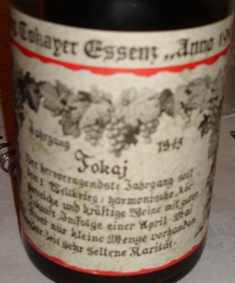
The Essencia Tokaji 1945 of Rainer is excellent. The sugar is heavy, but the botrytis is elegant. It tastes like over mature grapes burnt by the sun. Becoming more and more elegant, I appreciated it even if it is rather monolithic when compared with Yquem.

I am probably a bad judge for the Cyprus 1845 as I am in love with the wine. The smell is of pepper and liquorice. Deep as a perfume and invading. And in mouth, it is as if you look at the sun with your open eyes. You are hit by an unbearable flash. It is as if heavy liquid gold would be poured in my mouth. Complex, with an immense set of flavours, I adore it above everything. I can imagine that some friends, comparing it to Madeira could have been unimpressed by this Cyprus. But for me, the old muted wines are near alcohols when this Cyprus is a real wine like a Sauternes can be, and I love a length which never ends. I can imagine the pleasure my friends had with a cigar and this Cyprus.

We continued endless discussions in a bar with a juniper alcohol. We were happy.

What to say about this event? The Belgian friends and their friends are dynamic, know really the wines that they drink, share wines of a remarkable quality, and are of a great generosity.

The format of what I do is different as I open largely less wines; I care more for the food to create nice combinations. But such an event in a very friendly atmosphere and outstanding wines pleased me a lot.

I thank the Antwerpen group to have invited me to attend this very memorable event. I will remember that the country where people really drink wine is Belgium.

vins de Bouchard au Plaza Athénée mercredi, 15 mars 2006

Je quitte cette

Je quitte cette assemblée de solides débatteurs pour rejoindre Bouchard Père & Fils qui tient séance au Plaza Athénée, halte incontournable du monde du vin. En un circuit accéléré Stéphane Follin-Arbelet me fait goûter : Chevalier-Montrachet 2004, Montrachet 2004, Montrachet 1990 éblouissant que je connais sur le bout des doigts, Beaune Clos de la Mousse 2001 un peu fermé, le Corton 2000 et un magnifique Volnay Caillerets ancienne cuvée Carnot 1976 en magnum. La galaxie Bouchard Père & Fils a vraiment de grands vins. Le nom de Bernard Hervet est évidemment souvent prononcé. Je ne peux pas ignorer que c’est lui qui m’a initié aux vins du prestigieux domaine de Joseph Henriot.

Pape Clément 1989 mercredi, 15 mars 2006

With some friends, all born in the same year, we have created a club.

We meet once every two months, and the one who invites the others is always different.

We meet in Automobile Club of France where I am member.

Aperitif by the bar with a Moët & Chandon NV which has certainly more than 10 years. So the champagne has got signs of age, is a little smoked, and it is loveable.

I thought it would not be possible for the second bottle to be as good, but, to my surprise, it was as good. These champagnes, when they get a little age, are purely lovely.

I am not a big fan of Moët, except on vintage cuvées. But with age, it is largely better. It makes sense to store such champagnes for 10 years.


Then on a very ordinary cook (in school, I would give a note : "could do better"), we had three bottles of Pape Clément 1989.


Due to the cellar of the club (on Place de la Concorde) the wines get probably more age than in a normal cellar.

– the first was very balanced

– the second had a pronounced wood, rather charming, which pleased me

– the third had a little too alcohol in front of the scene;


But the three bottles had a common characteristic :

The wine is good. Really good. Very obvious personality, and what pleased me, did not try to show. Very balanced and not playing with its muscles.


I do not know how behaves Pape Clément now, under the leadership of Mr. Magrez, but this way of making the 1989 pleased me a lot.

A very pleasant wine.

I hope it is today in the same direction as this very charming, balanced, elegant Pape Clément 1989.

dinner by Ledoyen with a nice « Y » 1985 mardi, 14 mars 2006

I had been charmed recently by the cook of Christian Le Squer in Ledoyen, so I was afraid that a new try would be less emotional. My wife suggested that we invite friends for a dinner and I reserved there. As I write a bulletin which was sent to the director of the restaurant, I arrived before the others, welcomed as if I were Richard Gere entering a boarding school for young girls. If I arrived earlier, it is because my wife does not like that I spend time reading the wine list. I ordered the wines, and they arrived.

We begin with a champagne Gosset 1999. It is a champagne which has a very expressive taste. We had it with the “amuse bouche” made of four different pieces of a very clever and sophisticated cook, but I had an idea. I asked that each of us we receive an oyster. And the combination is magical. Since I have discovered this combination, I try to get it as often as I can.

We had an incredible menu. I write it in French :

Oursins de roche en coque à l’avocat, soufflé de corail rafraîchi

Grosses langoustines bretonnes croustillantes, émulsion d’agrumes à l’huile d’olive

blanc de turbot de ligne juste braisé, pommes rattes écrasée à la fourchette et montées au beurre de truffe

anguille fumée sur toasts brûlés à la lie de vin

carré de chevreuil, réduction d’une poivrade relevée de griottes

fromages

croquant de pamplemousse cuit et cru au citron vert

soufflé passion à l’ananas épicé, sorbet litchi

chocolat noir en fines feuilles croustillantes au lait de pistache glacé.

We had the urchin (delicious and airy) with “Y” d’Yquem 1985. I had this wine the last time I came, and as I adore this wine, I ordered it. And I did well. This wine is incredible. Such a personality, such a charm is incredible. But what is even better, it changes its personality by every combination with food. Kaleidoscopic, this wine amazed me by every sip. I adore this wine above many others due to its semi sweet discrete attitude behind the dry wine. And 20 years advantage this wine.

I had ordered a few hours before a Clos de Vougeot domaine Méo Camuzet 1998. This Clos de Vougeot has been the first wine that I had drunk of the Domaine, which made me adore the domaine. Since that, Jean Nicolas Méo became a friend. Of course, 1998 is young, but with air the wine broadened. And if it was not appropriate with the eel, it was fantastic with the roe-deer. A very pleasant wine, but it is not so good to drink it so young. It has many qualities and represents a nice form of the present Burgundies.

The cook of Christain Le Squer was fabulous, and the fact that I was pleased as the first time represents a very good point.

He cooks very naturally. It is extremely well built and realised, but it is mature, with no need to show.

Perfect on every course, I appreciate a lot. And I recommend the place.

But for my eyes, the star of the night (after my wife of course) is the “Y” d’Yquem 1985.

Visit to Chateau Margaux samedi, 11 mars 2006

After the dinner by Yquem, I went to meet Paul Pontallier in Chateau Margaux.
We tasted the Margaux 2004 : the nose is of spice, leather and the powder for make-up. In mouth, I find it in a closed phase.
The Margaux 2003 is a contrary. It has the greatest possible feminin charm. Absolutely sexy.
Having read the book "the Perfume" by Patrick Süskind on the impossible search for the perfect perfume, what I think immediately is that the nose of this Margaux 2003 is the one of the skin of a beloved woman. In mouth, the sensuality of Margaux explodes. I am not able to predict what it will be in 20 years. But for me, today, it is a pure devil buying your soul.

To drink a Pavillon blanc de Chateau Margaux 2005 looks like trying to discover the beauty of a Muslim woman wearing a burka. Lots of aromas, which is classical for well made white wines. But what to say ? More fruity than the Smith Haut Lafitte white 2005. Not more to say.

We arrive by ‘le lion d’or’, a restaurant that I did not know but that I recommand : the meat has a quality which is incredible. The chef is a nice man, easy, talkative. A pleasure.

I had brought for Paul to share with him a Riesling Zind Humbrecht 1983. We had it on "charcuterie", and it was absolutely impressive. Citrus fruit, artichoke, prunes, and a way of filling the mouth which has a lot of charm. A truly great wine.
On the lamb of Pauillac, we drank Margaux 1989 and Margaux 1990 from halves bottled originally in due time. So, no samples, original filling.
Paul wanted to check with me how we judge the two wines.
For me, it was not necessary to analyse or to describe why : the 1989 is enjoyable, full of joy, showing its best aspects, and the 1990 is reserved, discrete. So, no possible hesitation, the 1989 is clearly the best.
And, more than that, it is a great wine.

Then, if one wants to analyse, one can think.
It is possible to say that the 1990 has a great future. It is possible to say, as Paul said, that this half of 1990 was not at its best.
But one thing is true, and the only important thing is that we were there at this specific moment, without hesitation the 1989 is a glorious wine, and the 1990 will be an immense wine in 20 years.

We left half of the bottle of the Riesling to the chef who will enjoy it tonight.