I arrive by the restaurant of hotel Bristol to open the bottles for a new dinner. The bottles have been delivered one week before and were put standing in the cellar yesterday morning by Jerome Moreau, the efficient sommelier of the place. Some material is waiting for me and I appreciate that, as it shows the commitment of the staff. Ludovic, a junior sommelier will help me and will smell rare scents. This ceremony of opening has become a tradition.
I am extremely disappointed by the three red Bordeaux, which seem tired, which should not be the case. Mission Haut-Brion 1964 is a solid wine. This one has an extraordinary fill in the neck. So, it should be good. I am ready to declare it dead. The Ausone 1953 looks tired, the Coutet 1952 (the Saint-Emilion) looks tired too, but I have more hopes. Added to that, the Sauternes 1943 seems to be weak. I am disappointed, and even more, for a specific reason.
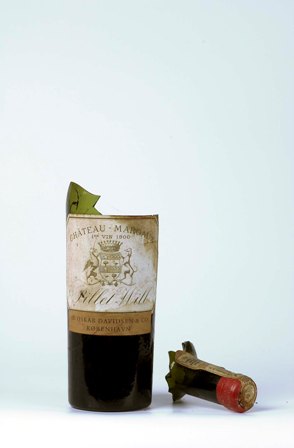
A TV Channel, Monte Carlo TV, will make a subject on my cellar in a few weeks. So, I asked a friend who is a sommelier to make my cellar a little more glamorous, and he found some bottles whose future is compromised. Having hurt a Chateau Margaux whose year could be 1931, he suggested that I drink it rapidly, and two other Bordeaux were in a bad situation and needed to be drunk rapidly too.
If I had added the 3 wounded Bordeaux to sound bottles, it would be OK. But if I add them to wines counting some weak wines, things are not so good. As I had taken with me two spare bottles in case of emergency, I decided to open them. So, instead of having 10 bottles for 10 people, we will have 15 bottles, due to the addition of the 2 of the reserve and the 3 wounded added. We will see that many surprises occurred.
The guests of the dinner arrive precisely at 8 pm and I give the instructions or « rules » in order to enjoy the dinner, while we drink a champagne Charles Heidsieck 1982 that I have added. The colour of the wine is of an elegant peach light gold, the bubble is still lively, and the champagne is a good way to show what happens with old wines which have integrated all their flavours. The small “amuse-bouche” are very spicy, which seems to be a “façon” of the chef. They make appear various aspects of the champagne.
The menu has been composed by Eric Fréchon helped by Jérôme Moreau, and my comments, which were not numerous, have been taken into account.
Here is the menu :
Chamalot parmesan, beignets de lotte, cornets de foie gras aux anguilles, maquis
Bouillon cube de foie gras de canard, langoustines mi cuites au gingembre, coriandre et cébettes
Topinambour et truffes noires, cuites en croûte de foin, bouillon mousseux au jus de truffe
Filet de Sole farci aux girolles, sucs d’arête réduit à peine crémé
Pot au feu de cochon et bœuf, volaille au foie gras, os à moelle et céleri rave
Fourme d’Ambert
Poire caramélisée cuite à l’étouffée, jus aux zestes de clémentine semi confite, glace à la vanille
It was a truly comfortable menu as it was not too provocative, and was designed to help the old wines to shine.
In our group, three people had already attended a previous dinner. We had French, Belgian and Luxemburg people around the table. Many people from business and finance, and a man managing a group of restaurants.
There was a big contrast between the first champagne and the Laurent Perrier cuvee Grand Siècle from a recent release, with wines coming probably from the period 1995 to 1997. If the first was masculine, this one is outrageously feminine, seducing, with an immense power of evocation of white flowers as the ones which accompany the new design of Laurent Perrier. It has the charm of a sophisticated strip tease.
The Gewurztraminer Gustave Lorentz réserve 1966 is one of the greatest surprises of this dinner. The nose was very generous by opening some hours ago, and when drinking it, it is really flashing. It is not a late harvest so some points of dryness are really exciting. It is enigmatic and very successful. On the soup, it shines marvellously. A great wine and a great combination. I heard many “oh” and “ah” as everyone was amazed by this level of quality of a perfectly kept wine.
The Jerusalem artichoke of Eric Fréchon is exceptional. I had said so many nice words on the rare Montrachet Comtes Lafon 1990 that when it appeared, all of us we were surprised. It is a great wine, with a light gold in colour, a nice smell, but it is as if a car was on the first gear and could not go to the second one. We can feel the promise of a great wine, but we have not the true Montrachet that we were expecting.
Eric Fréchon had thought of a provocative choice to associate the course with a white and a red. And I had said yes. So, La Mission Haut-Brion 1964 was served at the same time as the Montrachet. And the surprise came from this wine, which I would have declared dead, and which came back to life due to the oxygen. Of course it was not the most brilliant example of a Mission 1964, but it was really expressive. And the truffles doped it. And as the Montrachet was playing under its category, it helped to make the Mission even more loveable.
On the sole, two wines. Objectively, it is the Château Coutet Saint-Emilion 1952 which is in the logic of the fish course. The wine has suffered. A little roasted, truffle like, it goes very well with the sauce. The Château Ausone 1953 starts slowly. Polite, it begins by being discrete. But when it is installed in the glass, we can see all the charm of this great wine. It is very intelligent, not invading, but sufficiently great to be appreciated by all.
On the “pot au feu”, we will have three Burgundies instead of two, as I had added the Corton.
The Chambolle Musigny les Amoureuses P. Misserey et Frère 1981 is extremely charming and performs largely better than what could be expected. Very young but altogether evolved, it is warmly sympathetic. The Le Corton Bouchard Père & Fils 1980 has a very clear message, as in a Chinese calligraphy. I love these Burgundies. And the Chambertin Charles Viénot 1934 is highly emotional. I had acquired this wine on the public sale of the cellar of Pierre Cardin in Maxim’s, and up to now, every try had been convincing. This wine is perfect. The structure is precise, dense, signalling a truly great wine. What is amazing is that critics could be made to the Bordeaux, even the most noble, and that no critic could be made to the three different Burgundies. This happens once, tonight, and cannot be considered as general.
Then we tried the three added wounded wines. The Chateau Margaux 1931 has been bottled by a merchant some decades ago and has no year on the label. As I wanted to know, we drank it with experts some years ago, and the central idea was 1931. A weak year, but a pleasant wine. And this one, just wounded by a manipulation of my friend was spectacularly good. So, this addition could sweep all the interrogations on the previous Bordeaux. We enjoyed a truly great Margaux.
The two others had not the same presentation. The Lynch-Moussa 1953 was undrinkable, and the Château Trottevieille 1967 could have been tried, but there was no need to insist, so I rejected it.
The Haut Sauternes Guillaume 1943 has a nice colour of a Sauternes of this period. The smell had been discrete and remained in the same stage. But the fourme d’Ambert helped it to appear a little intelligent. It was pleasant for a while.
Now, it is possible to forget anything as the Chateau d’Yquem 1936 is absolutely exceptional. I had already drunk this year, but this bottle is above any of my expectations, and by far. I consider generally that the decade 30ies gave, with the exception of 1937 wines with a low botrytis. But this one is against my analysis. This Yquem is a Yquem full of joy, with fantastic expression of fruits with an orange colour : apricot, mango, some sorts of prunes, yellow peaches, and it is wonderful. It is this type of Yquem that I love, and tonight I loved it more than the last 1937 that I have drunk.
The pear of Eric is very tasty, but does not add anything to this shining Yquem which needs to be drunk alone.
We have voted as it is traditional.
The Yquem won 7 votes as first, the Chambertin 1934 got one vote as first, as is the case for the Laurent-Perrier and the Gewurztraminer.
The consensus of the votes was in favour of Yquem 1936, Chambertin 1934, Gewurztraminer 1966 and Ausone 1953.
My personal vote has been :
– Yquem 1936
– Chambertin 1934
– Gewurztraminer 1966
– Ausone 1953
The bad surprises were the Mission 1964 with a super high fill and the Montrachet Comtes Lafon 1990 for which I do not understand the underperformance.
It appears that the bad performing were not the oldest ones, which gained the best votes.
But it shows that wine collecting is not a quiet hobby.
And it shows too that the oxygenation helped a lot to make some wines better than they would have been with another method. The Coutet 1952 and the Margaux 1931 have benefited from the oxygen.
Eric Fréchon has made a very intelligent cook as he acted to enlarge the quality of the wines. The service has been perfect.
Despite the dissatisfaction that some of my “children” did not perform as I would have liked, this was a great dinner, with, once again, a wonderful and impressive Yquem.
 Bingo !