an immense Henri Jayer wine and a so-so Coche-Dury by Michel Bras dimanche, 16 avril 2006

I have celebrated with my wife the anniversary of 40 years of our wedding. We went to Laguiole, in the hotel and restaurant of Michel Bras.
To go to Laguiole is a real adventure as this hotel is in the middle of nowhere.
The building is extremely modern and expresses the personality of Michel Bras, the son of this difficult and poor region.
We spent two days, which gave us two opportunities to discover the way of cooking of Michel Bras. In a recent study, classifying the chefs, he was named number six in the world, and second French, just after Gagnaire.
The way of cooking has a high level of perfection. But the will to show many different tastes in the same preparation does not correspond too much to my personal search. So, compared with a Marc Veyrat whose creation is endless, I must say that I was more attracted by the style of Veyrat than by the very proper and justified style of Michel Bras.
The greatest splendour of the place is the wine list.
I complain with the Parisian wine lists which have insane prices. There the prices are absolutely normal and show a very appreciable approach.
In such a case, I want to show a sign by ordering nice wines, to give, at my modest level, a reward to their attitude.
So, the first dinner I ordered a Vosne Romanée Cros Parantoux Henri Jayer 1992. I had almost tears of pleasure with that incredible wine. I would be happy to know if some people who have drunk this wine have had the same impression.
The nose has the smell of a jam of red berries. It is sweet, candied fruits, smells of jam of roses. It is like a perfume. And in mouth this is the ultimate form of an easy wine. The wine tastes as if it was a new born wine, just taken from the barrel. And it is a easy as a village wine. It is so pure, so direct as if it were just pressed. It is, for my opinion, the definition of a pure wine, as the David of Michel-Angelo is the pure definition of the proportions in a human body. I was pleased at an immense level, saying every minute to my wife how I enjoyed this wine. It is certainly my best ever Henri Jayer.
The second day, I ordered a Corton-Charlemagne J.F. Coche-Dury 1997. By the first smell, I knew that it did not please me. The first smell was mineral, like petrol, but this petrol disappeared. The wine, for me, was too much. There was power, and not elegance. Of course it is a great wine, but after the seduction of the Henri Jayer, this wine, much worked, did not please me. I cannot be suspected to have anything against Coche-Dury, as I have adored the CC 96 and the 90. But this wine was too much. And I was desperate, as it was our wedding anniversary. I felt trapped by this wine. So, I drank it as I felt that it would have been too much to change for another wine, as it represents a great wine.
And my patience was rewarded, as at the moment of the cheese course, I saw a local cheese, a Laguiole of 6 months, which is like a Cantal, a little softer. And the CC plus the cheese went wonderfully together.
The cook of Michel Bras, made of very authentic tastes, with a regional expression was marvellously enlarged by the authenticity of the Henri Jayer wine. The Coche-Dury, more civilised than authentic, more urban modern style, was not adapted to this cook.
So, one great wine at an unbelievable level. A great wine not giving me the pleasure I was looking for. The world of wine is full of surprises.
Le rapport avec le vin : plaisir ou domination ? vendredi, 14 avril 2006

La dégustation à l’aveugle, ou le besoin de noter, correspondent à un rapport d’autorité avec le vin. Avez-vous remarqué les gens qui ont un chien? Il y a ceux qui entretiennent avec leur chien un rapport confiant. Le chien est vraiment l’animal de compagnie. Et il y a ceux qui ne voient en leur chien qu’un objet de domination. « Ici », « couché », « non », « tranquille », « rapporte », … Ces comportements d’autorité compensent certainement un mal être.

Peut-on pousser l’analogie avec le vin ? Pourquoi ce besoin de noter, de juger, de proclamer qu’un petit vin à deux sous vaut plus gustativement qu’un grand cru encensé ? Est-ce pour compenser un mal-être par rapport au coût des vins ? Est-ce pour justifier que n’ayant pas les moyens d’acheter les plus grands vins, il faut une désacralisation des idoles ? C’est peut-être aller trop loin, mais ce besoin de juger, de montrer qu’on domine le vin au point de le noter, de le classer, d’en faire un bon ou mauvais élève procède d’un manque de sérénité.

On ne mange jamais trois gigots en même temps pour dire quel est le meilleur. Pourquoi ne pas profiter d’un vin pour lui-même ? Sans ce besoin de domination qui donne à l’amateur le sentiment qu’il est le juge suprême. On gagnerait beaucoup à bien séparer la fonction achat, dans laquelle il est logique et judicieux de comparer de la fonction plaisir, où le fait de boire un vin doit être une rencontre entre le message d’une terre, d’une appellation, d’un vigneron, d’un vinificateur et d’un dégustateur.

Je rêverais de commentaires où celui qui a bu dit : « c’est bon ».

Dom Pérignon 1998 and a surprising Lafite 1981 jeudi, 13 avril 2006

I am in my house in the South.

I have just received my new jet ski, so it was an occasion to celebrate that.

I invite two friends with my wife and we go to a small restaurant directly on a beach.

I think that to begin with Dom Pérignon would be a bad thing as our mouth is not prepared, so I order a Champagne Mumm Cordon Rouge.

After the week-end I spent with Moët & Chandon this champagne makes me a shock : no personality.

But slowly the Mumm broadens and becomes civilised. Not to jump to the ceiling, but drinkable.

The contrast is what I wanted : the Dom Pérignon 1998 shows immediately the huge difference. A loveable champagne. Not really drinkable at this age, but already very enjoyable. A very great length and a promising complexity.

I had brought with me Chateau Lafite-Rothschild 1981, just opened when I arrived, so having only 1.5 hours of breathing, a fill in the neck, and immediately a sensual smell that I would never expect from a 1981.

There is a seriousness which belongs to Lafite, but a very deep structure, a joy of life, an expansion in the mouth that surprised me as I did not expect as much from that wine. One would have told me that it was a 1986, I would not have been too surprised.

On a fish (loup or bar in French), it was purely delicious.

Wanting to be nice, the owner of the place offered me a marc de provence.

Almost as ugly as the ugliest grappa. Something which, when you drink it, makes holes in your shoes’ soles.

A very enjoyable dinner, with a surprising Lafite 81.

galerie 1899 samedi, 8 avril 2006

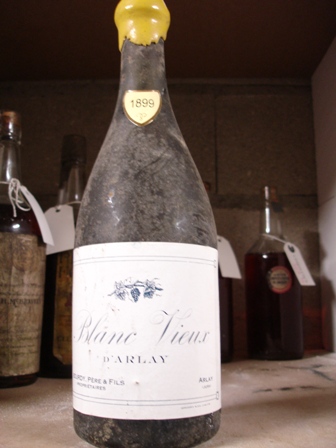
Blanc vieux d’Arlay Bourdy Père & Fils 1899.

Ce vin est exceptionnellement bon. Je suis amoureux de cette étiquette à la simplicité évocatrice de perfection.

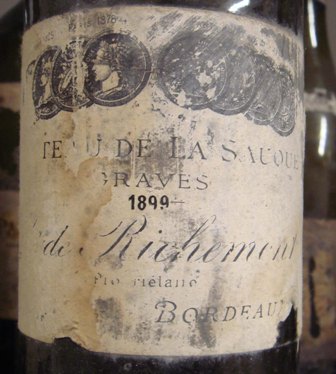
 Chateau de la Sauque 1899, vin de Graves qui a sans doute disparu. Bouteille d’un ami ouverte lors d’un dîner de lancement de wine-dinners, avant le N° 1, en décembre 2000.

Nuits 1899

Un article dans le Financial Times dimanche, 2 avril 2006

Dans le numéro du 2 avril, il y a un supplément mensuel du genre "art de vivre.

Un article parle des dîners avec des vins anciens. Le texte me concernant est le suivant :

"Yet another variation on the wine dinner theme can be found in France where the delightful French collector and bon vivant François Audouze continues to organise his extravagantly hedonistic – yet immaculately discreet wine dinners for like-minded epicureans. Formerly the CEO of steel company Arus, Audouze was looking for a way of sharing his passion for wine and food and hit upon a remarkably simple concept. Every month, Audouze’s website invites nine paying guests to an undisclosed two- or three-Michelin starred restaurant in Paris where he and they will enjoy 10 rare and exquisite wines from his magnificent personal cellar. (His pre-1945 collection alone accounts for over 10,000 bottles. “Younger” vintages are even more plentiful.)

Audouze not only hosts his hedonistic dinners (which usually cost just under € 1,000 / about £580 per person), he also selects the wines (and to an extent the food) so that not two events are the same. The result is a truly eclectic mix of wines and venerable old vintages. For instance, the dinner in January included an 1893 chateau Guiraud, a Nuits Saint Georges from 1915, a 1938 Mouton Rothschild and a 1954 Cos d’Estournel. All of which made Domaine de la Romanée Conti 1976 Grands Echezeaux and the ’82 Salon look positively infantile in comparison.

Audouze started his dinners about five years ago and now offers tailored events for companies too. As a result, his dinners attract aficionados from all over the world. Mostly, though, the people who attend tend to be men. “but at our next dinner we have four women, which I like. If it is all male, it can turn into a combat de coqs which I would rather avoid”, he adds.

Unlike most wine dinners, Audouze never does themes that focus on a single vintage or chateau. “Partly, this is because it then becomes an intellectual exercise about which wine is best”, he says. “Instead, I want people to enjoy and understand the wines rather than judge them. So my rules are simple. If you know something about wine – forget what you know. And if you think you know nothing about wine – forget that too”. Certainly, his dinners have occasionally been known to upset the form guide. “Once, we ranked a 1947 Moulin à Vent Beaujolais above a 1934 Latour”, says Audouze. ‘I love it when that happens, because it shows just how surprising and exciting wine can be”.

Ce n’est pas mal du tout.

La revue : Financial Times du 1 et 2 avril, supplément mensuel "How to spend it" avril 2006, page 66/67.

a lunch on a beach, in the sun, a promise of Summer dimanche, 2 avril 2006

With my wife, we went a week ago to Marc Veyrat in Megève.

I will make a subject about this lunch, as we explored wines of the Rhone, some of them being magnificent.

Marc Veyrat is a genius. I was wondering if a new experience would make me as happy. I was.

Then, I drove to my house in the South of France, in a lovely place on the sea. For the week, no drop of wine was on my planning.

But friends announced that they would come to visit me, and we went to a small restaurant which is one the rare places installed directly on the strand. They have put tons of white sand, so the place has an atmosphere of a small Saint-Tropez, the prices in less and the top models in less. But the place is charming. The name : “Le Day” in Hyères, near the airport, on the beach.

Last year was their first installation and they had a good idea to have Dom Pérignon and Cristal Roederer for affordable prices. They had reopened the day before, so their cellar was nearly zero.

I asked them to go and buy wine as I would come back with friends. And they promised me that they would have nice fishes.

We began with a Cristal Roederer 1999. I must say that I was very disappointed by this champagne that I found too “dosé”. Much too sweet for me. I would be happy to receive comments : am I wrong ?

Fortunately, the waiter came with huge plates of urchins (offered), and with the sweet taste and iodine taste of the urchins, it went largely better. But, I was disappointed.

Then a Blanc de Blancs Domaine d’Ott 2003. I am always hesitant when Ott is concerned, because Ott is a “must” as Dom Pérignon is a must. So, I am always cautious. But I must say that I was bluffed by this wine which was extremely intense, deep and with a great personality. I had it on a Carpaccio of salmon. I have loved this wine.

Then on a sea bream, I had ordered a Bandol, Chateau Salettes red 2003. Very nice, but largely less convincing than the white. And after that, a Chateau Jasson red Cotes de Provence 2004 was promising, but largely too young for me.

Such a lunch on the beach with a little wind but much warm sun is a promise for Summer.

I enjoyed the Ott.

A nice day.

un achat, chat en poche, se révèle un bel achat vendredi, 31 mars 2006

Achat, chat en poche !

Je reçois environ 10 / 15 offres par semaine de vins à vendre.

Généralement, je réponds : « la valeur gustative de vos vins étant supérieure à la valeur financière, je vous conseille de les boire ».

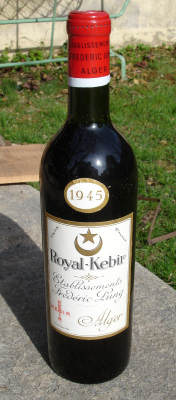
Un jour, quelqu’un me propose des Frédéric Lung, Royal Kébir, vin d’Algérie.

Là, stop, on cause.

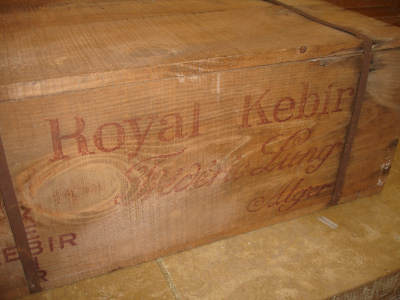
Le vendeur me dit qu’il a une caisse en bois de Lung, et que ce doit être des années 50, et qu’il doit y avoir 4 rouges, 4 blancs et 4 rosés.

Je formule un prix en disant : sous réserve de les voir.

Nous avons rendez-vous à Hyères, sur le port, et je découvre cette caisse. Monsieur est venu avec madame, et ce couple de retraités est évidemment inquiet de savoir si la transaction se fera.

Je demande si on peut ouvrir et le monsieur me dit : « vous n’y pensez pas. D’ailleurs, pour un collectionneur, c’est la caisse entière d’origine qui a de la valeur ». Quand je lui dis : « mais c’est pour les boire », le monsieur se dit que je dois être un fada.

Nous récapitulons ce qu’il me vend, chat en poche donc : quatre bouteilles de chacune des couleurs, années 50.

Je reviens juste d’avoir ouvert la caisse :

          quatre rosés sans année, bruns comme des figues sèches, d’excellent niveau

          huit rouges 1945 dont une seule est haute épaule, les autres dans le goulot.

Bingo !

J’ai déjà bu Frédéric Lung 1945. C’est un vin de légende.

Dans le club dont je faisais partie, où les dégustations se faisaient à l’aveugle, les Lung damaient le pion aux bourgognes des années trente et quarante.

Bonne pioche.

Je suis ravi.

Le monsieur doit l’être aussi, car il doit considérer comme fada une personne qui paie aussi cher une caisse de vins sans doute définitivement morts.

Je suis estomaqué des niveaux de ces vins.

galerie 1900 mardi, 28 mars 2006

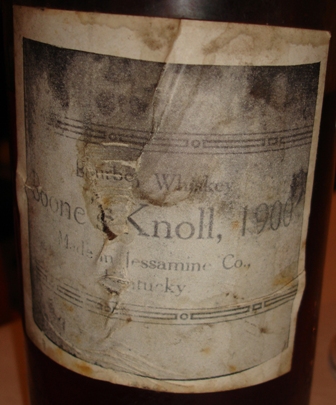
un magnifique Bourbon 1900 bu à l’Astrance en novembre 2006

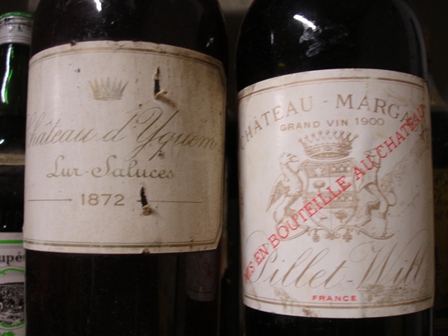
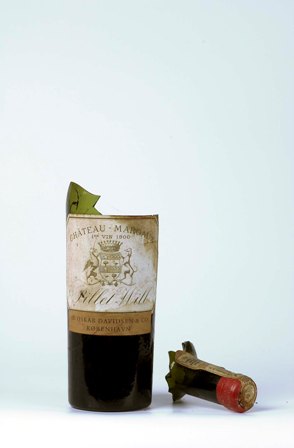
Margaux 1900, ici à côté d’Yquem 1872. C’est une de ces bouteilles que j’ai cassées un jour de malchance…

C’est cette photo qui a fait la couverture de mon livre "carnet d’un collectionneur de vins anciens", paru aux éditions Michalon.

 On notera la différence entre "premier vin" et "grand vin".

La phrase absconse du bulletin 172 lundi, 27 mars 2006

Lors de l’envoi du bulletin 173 par email, j’ai créé un petit concours pour inciter les lecteurs à lire mes bulletins et à consulter le blog. Voici la formulation :

« Il y avait dans le bulletin 172 une phrase volontairement absconse. Les quatre premiers qui en donneront la clef, avec l’explication exacte, partageront avec moi une Yquem. Pour le plaisir. La solution sera donnée dans une semaine sur le blog. On l’aura compris, c’est pour animer la lecture de ce bulletin et créer le réflexe de consulter le blog. »

Il fallait trouver la phrase. La voici : « Le président de l’automobile club de France déclare ouvert le dîner annuel de l’Union des Grands Crus. Il rappelle, mais avec des mots plus choisis, que Noé fut le premier à faire rougir l’alcootest, et avec un langage fleuri, il nous compte l’histoire de la vigne. Quand au bout de cinq minutes on en est encore à Horus et Osiris, on se dit que la soirée sera longue, mais son discours fait « pschent », ce qui est assez abracadabrantesque, et c’est au tour du président de l’Union des Grands Crus de s’exprimer. »

La clef de l’énigme est la suivante : les interviews de Jacques Chirac le 14 juillet.

Une année il dit que telle ou telle affaire ferait « pschitt ». Une autre année il trouva une question « abracadabrantesque », exhumant un mot de Rimbaud. Le discours de président s’annonçait fort long si l’Egypte prenait tant de temps. Or son discours s’arrête. Il fait pschitt. Comme on parlait de l’Egypte, il fait pschent, puisque pschent est la coiffe des pharaons. Ce brusque arrêt du discours est curieux. Il est donc abracadabrantesque. La logique élyséenne était dans cette phrase.

Les vainqueurs sont trois.

Nous boirons ensemble un vieil Yquem. Je le raconterai.