Archives de catégorie : dîners ou repas privés

rencontre de forums – un immense La Tour Milon 1926 vendredi, 9 juin 2006

Sur des forums internet, des liens se sont créés, et des rencontres de moins en moins virtuelles nous réunissent. Ce soir, c’est un dîner à la brasserie Dauphin qui rassemble onze passionnés de vins, dont un couple d’allemands, un couple de texans, un couple de suisses, un hollandais et le reste de français. L’idée est de partager nos vins et nos impressions.

Faute de temps, je n’ai pas pu me concerter avec le chef sur le menu. Aussi, la cuisine, que j’apprécie souvent, va ici jouer son numéro sans se soucier de ce qui se passe du côté des vins. Cela permet de prendre conscience du fait que les beaux accords ne sont pas le fruit du hasard. Voici le menu : langoustines rôties, vinaigrette de pomelos et melon / raviole de crabe au jus de bouchot / gâteau de cèpes de printemps au foie gras grillé / suprême de pigeonneau rôti au jésus de Morteau, jus simple / la tomme de chèvre au raisiné / le cakaille pistache aux fruits rouges. Rien ne fut mauvais, rien ne fut bon. Mais c’est ma faute : pas de concertation suffisante. Regardons du côté des vins.

Un champagne Salon « S » 1983 dégorgé le matin même et non dosé, voilà un beau début. Champagne à la forte personnalité,  original, typé, vineux, dense, présent en bouche, il forme un contraste absolument intéressant avec le champagne Bollinger R.D. 1982 dégorgé en 2000 et très faiblement dosé. Le Bollinger est un vrai champagne, à la bulle active et puissante. Si l’on devait désigner des deux lequel est du champagne, c’est sans hésiter le Bollinger, magnifique de jeunesse, de rayonnement et de pureté. Le Salon, c’est autre chose. C’est du vin. C’est un vin qui appelle une cuisine, pour se frotter avec des saveurs étranges qui vont le mettre en valeur. Faut-il en préférer un ? Bien sûr que non. Il faut aimer les deux.

Ayant ouvert toutes les bouteilles (ça devient une habitude) qui avaient été apportées à ma demande en avance, j’avais ouvert le Montrachet Bouchard 1980 vers 19 heures. Sa couleur fort ambrée et son nez fatigué m’avaient poussé à annoncer aux convives de se méfier de ce vin là, et de l’approcher avec précaution : tout jugement hâtif prononcé sur l’instant empêcherait  de comprendre ce vin. A ma grande surprise, le vin existe. Et non seulement il existe, mais il parle. Ce n’est évidemment pas un Montrachet flamboyant et fougueux. Mais il est élégant, centré sur ses valeurs de base, et il joue sur un registre de finesse qui le rend plaisant. On ne joue pas à plein régime, on suggère en délicatesse.

Le Château L’Evangile, Pomerol 1998 plait instantanément à cette assemblée qui ne vit que de vins jeunes. Beau nez épicé, belle structure joyeuse en bouche. C’est un vin serein, dans la plénitude absolue de ses moyens. Vin très bon. A côté de lui, le Château Magdeleine 2001 fait plus sénateur, bourgeois. Il est confortable. Ah, il ne va pas faire l’école buissonnière ! Mais comme il est, déjà accompli, propre sur lui, c’est un agréable compagnon de jeu.

Le Gruaud-Larose 1986 est trompeur. Car il joue en sourdine en début de verre. Et quand il s’installe, quelle merveille de joie de vivre. C’est un vin sans défaut. Il ne brille pas par des risques insensés. Il fait son devoir. Servi en même temps, le Château Ausone 1983 éclipse le beau Gruaud-Laroze. Car cet Ausone est immense. Est-ce cette bouteille qui est particulièrement brillante ? Toujours est-il que l’amoureux d’Ausone que je suis prend un plaisir incontrôlable. C’est immense, je le redis une nouvelle fois. Comment décrire cette petite merveille de précision ? Un vin qui chante, qui s’installe en bouche comme en un canapé profond. Si Saint-Emilion a un type, ce n’est pas avec ce vin étonnamment charmeur qu’on le reconnaîtra. Je le désignerais volontiers comme vin de la soirée si n’apparaissait le Château La Tour Milon Pauillac 1926. D’un niveau dans le goulot, d’une couleur irréellement jeune, au nez fruité et joyeux, ce vin, s’il était bu à l’aveugle ferait se tromper tout dégustateur de plus de vingt ans. On me dirait 1964, voire 1961, je ne dirais pas non. Toute la table est estomaquée. Et ce d’autant plus que nous parlions de la courbe de la vie du vin. Je défends un parcours sinusoïdal à périodes irrégulières, alors que le schéma traditionnel commande un plateau de maturité et un déclin. Quand on voit ce 1926, quand était son pic de maturité ? Aucun schéma politiquement correct ne s’applique à ce vin. J’avoue qu’il constitue pour moi une énigme, car il est grandiose. Décidément, l’année 1926 que j’adore ne m’apporte que des surprises extrêmes.

Je suis servi en premier du Richebourg Charles Noëllat 1973. Ce sont donc des gouttes très légères et pâles qui se déversent dans mon verre. J’annonce donc un grand danger (je préfère toujours commencer par un discours pessimiste pour que mes convives aient de bonnes surprises. Et le Richebourg, objectivement fatigué, séduit par son message bourguignon authentique. Il joue manifestement à 80% de sa valeur, comme une équipe de France sans Djibril Cissé, mais ce qu’il raconte est loin d’être sans intérêt. Il aurait dû être bu il y a au moins dix ans. Mais il est là, écoutons-le.

Alors, quand arrive le Clos des Papes Châteauneuf du Pape 2003, ça décoiffe. Car là, ce n’est plus pareil. C’est Monsieur Robert Parker en smoking. Tout y est. C’est le kit complet du petit Parker illustré. Vous voulez du poivre ? Il y en a. Vous voulez du jus de cassis, ça baigne. Vous voulez du copeau, il infuse. Du clou de girofle, c’est une pleine moisson. On ne peut pas dire que c’est désagréable. Car ça flatte et excite la papille. Mais on est entré dans un monde du vin qui pourrait sortir d’un laboratoire et n’a plus aucun besoin de terroir. Je dis ça d’autant plus volontiers que j’adore les vins de Paul Avril quand ce sont des Châteauneuf du Pape.

Le nez du Christoffel WS Riesling Auslese 1976 est d’une promesse quasi irréelle. Magique. C’est le champion du Monde du nez. Hélas en bouche, on en est loin. Il y a de belles variations sur le thème du Riesling, avec des suggestions de complexités ravissantes. Mais c’est l’intégration du tout qui manque. Le nez et l’attaque en bouche annoncent un triomphe, et ça finit comme Clearstream.

Il faut aimer les vins de glace. J’en ai aimé la découverte. A l’usage, c’est comme avec les muscats de Beaumes de Venise, on en a un peu fait le tour. Alors, ce Karlsmühle Eiswein 2002 est amusant par ses évocations étranges où le litchi prend sa part. Mais ça s’arrête là.

Le Malaga Larios, solera 1780 a forcément quelques molécules du 18ème siècle. On s’amuse de cette datation généreuse. Mais ce vin mérite d’être pris au sérieux. Il y a assurément une part non négligeable de ce vin qui a plus de 150 ans, et certainement plus de cent ans de fût. On sent que cette date n’est pas qu’un baptême ambitieux. Il y a un charme qui ne peut provenir que d’un grand âge, et le rapprochement gustatif avec les Commandaria de Chypre indique l’authenticité de la vétusté respectable de ce grand vin doux de pur charme, que l’on siroterait pendant des heures si l’on avait encore une petite place dans son cœur, après tant de belles bouteilles.

Si l’on parle de goût pur, c’est Ausone 1983 que je placerai en premier. Mais si l’on intègre d’autres dimensions de rareté, de surprise, d’étonnement, c’est le La Tour Milon 1926 qui ramasse la mise. Mon classement sera donc : 1- La Tour Milon 1926, 2 – Ausone 1983 3 – Malaga 1780, 4 – L’Evangile 1998.

Les forums gagnent en intérêt dès qu’ils cessent d’être virtuels. Cette assemblée qui n’est plus virtuelle se revoit ce soir pour de nouvelles agapes.

un Schlumberger 1945 dans un déjeuner d’amis lundi, 22 mai 2006

With some friends of the same age, we meet every two months. One of my friends asks me to find a pleasant restaurant, as he was the one whose turn was to invite the others. So, I make a reservation by the Bistrot du Sommelier. I arrive first in the restaurant, and I say that I would like to say hello to Philippe Faure-Brac, owner of the place, and former best World sommelier in 1992. The chief waiter, whom I know well says : “he is making a tasting in the private room, so he is busy”. I ask : which wines is he tasting? And the answer is : “Domaine Schlumberger”. So, I declare : “I will go there to say hello”.

I arrive in the room where I find many journalists that I know, and Philippe welcomes me by saying : “some people have a great nose : why did you reserve the precise day when Schlumberger presents its wines to the press?”. I shake the hand of a woman whose name is Schlumberger, and wanting to parade, I say : “in my cellar, I have some 1945 Schlumberger”. And the woman, with a smile, answers : “it’s a good thing as you will taste it today”. I was so amazed, and bluffed! A booklet was given to me, and I began to taste as the journalists around me, thinking anyway that I should hurry, as my friends should come. To be polite, I begin with the youngest wines.

Here are some notes made in a hurry :

The Kitterlé Riesling Schlumberger Grand Cru 2005, put in bottle for a few weeks only is really very drinkable, which is remarkable. It is classic that a very young wine is charming, then shuts itself before expanding again.

The Kitterlé Riesling Schlumberger Grand Cru 2002 is magnificent. Smoky, with a little taste of almond. I like it as it is round and pretty.

The Kitterlé Riesling Schlumberger Grand Cru 2001 is more strict, closed.

The Kitterlé Riesling Schlumberger 1979 has a superb nose, very friendly. It is mineral but joyful. The mouth is more closed than the nose. I feel it as a wine of great gastronomy, promising complex combinations.

The Kitterlé Riesling Schlumberger Grande sélection 1955 has a nose which is more discrete. The mouth pleases me. It is not a typical Riesling, a little evolved, but I like it. It is refreshing, easy in mouth, and a great wine for gastronomy. I know that I will surely love it more than the journalists around me as they will report on more conventional Rieslings as the 1971 that they adored and that I did not try.

The Kitterlé Riesling Schlumberger Grande sélection 1945 has a nice golden colour. The nose reminds me of someone who smokes a pipe. In my mouth, it is a nectar. It is round, fruity, expressive. The length is great. It is a great wine.

I rapidly join the table where my friends wait for me, and, as it happens, I am asked to order the wines.

I order champagne Lenoble, Grand Cru Blanc de Blancs 1995. I like this champagne, very expressive, well designed. It is pure and gives pleasure.

The Bâtard-Montrachet Domaine Leflaive 1998 is powerful and generous. It is a bomb. It is very difficult to associate any meal, as the wine invades the palate. But on a foie gras in terrine that I had ordered, it went very well.

The La Mission Haut-Brion 1997 is absolutely passionate. The advantage of this year is double. First, it is less expensive on the wine lists. So, ordering for a friend, he forgives me. The second reason is that the supposed lightness of the year helps to reveal the real charm of the wine. And I adore such a tasting. This wine has a very dense structure which is the signature of a great wine. On a fish (bar), it was a nice combination. I ordered then Trotanoy 1997, chose by me to have another bank for the same year. The two wines are absolutely charming, full of grace. And while sipping the Trotanoy, I think that I would be unable to say which one is the best, as they are completely different, Mission being velvety and charming, and the Trotanoy winy, fruity. I would anyway vote for Mission due to the density of the structure.

Then, Philippe came to our table with for each of us a glass of Schlumberger 1945. More opened, more tasty, more fruity, this wine was a delight to conclude a nice friendly lunch.

un fabuleux Haut-Brion 1922 dans un dîner impromptu samedi, 20 mai 2006

Jean-Philippe Durand est cet ami qui avait réalisé trois jours de cuisine de rêve dans ma maison du Sud en fin d’année 2005, qui nous avait initiés à la magie de Marc Veyrat et qui avait fait la cuisine d’un repas où je voulais convaincre des membres d’un forum sur le vin de l’intérêt des vins anciens. Il me propose des dates de rencontres, toutes plus alléchantes les unes que les autres, mais ce sera pendant la longue trêve d’été que je compte prendre pour me reposer de toutes les aventures invraisemblables de cette première moitié de l’année. J’ai un défaut, je n’aime pas dire non. Alors, de façon impromptue, nous organisons un dîner chez lui pour le lendemain. Nous serons sept, dont des partenaires d’aventure à Megève, dans le monde créatif de Marc Veyrat. Je suis en cave, choisissant des bouteilles comme je le ferais pour mes enfants, c’est-à-dire vins à découvrir, bouteilles à niveaux incertains, curiosités. J’appelle Jean-Philippe pour lui faire part de mes choix. Je sens sa moue au bout de mon oreille. Il me demande des bordeaux, et dans le mail qu’il m’adresse, d’ajustement des apports, je sens qu’il veut du grand. Je n’aime pas qu’on empiète dans mon champ de liberté, mais pour Jean-Philippe, j’ai envie aussi que ce soit grand. Je n’ouvrirai les vins que vers 19 heures, car je ne veux pas déranger le chef chez lui.  

Il a beaucoup à faire, jugez-en par ce menu : Palourdes, filaments de navet, jus marin / Foie gras fondant, pommes à l’orientale / Grenadin et ris de veau, coulis aux cinq épices de Chine, poêlée de fèves / Homard breton, arômes de truffe blanche, asperges violettes, mousseline aux fanes de navet / Saumon mi-cuit à ma façon, morille d’Auvergne, goutte de framboises "Ardalya" / Foie gras vapeur, betterave et balsamique, jus sauvage à la truffe / Suprême de pigeon, truffe noire, sauce aux foies, petits pois à la coriandre / Stilton / Tarte aux poires et aux pamplemousses / Charlotte aux framboises.

Quand Jean-Philippe cuisine, ce n’est pas un vain mot. Chaque composante, chaque produit, chaque sauce sont dosés avec une précision horlogère. C’est du niveau des montres à complications. A l’ouverture, le bouchon du Haut-Brion 1922 se brise en mille morceaux, et dégage un parfum de truffes et de chocolat. D’autres bouteilles ont des souffrances. On le verra.

Le temps que l’on soit prêt pour le dîner, je suggère que l’on commence par Château Figeac 1967. Quand j’étais en cave, parlant à Jean-Philippe, j’ai saisi cette bouteille dans un casier. Belle étiquette, apparemment très beau niveau, trop beau niveau. J’ai le téléphone à l’oreille, je tiens la bouteille d’une main. Le niveau me parait irréel. Je monte la bouteille jusqu’à mes yeux : le bouchon était tombé dans la bouteille. Elle fut apportée (plutôt que de la jeter, autant vérifier). Décapsulée à 19 heures, d’odeur très acceptable, elle fut carafée. On sent que ce vin pourrait revivre. Mais le défaut, même minime, ne donne pas l’envie d’aller plus loin. Jean-Philippe aura peut-être demain à midi un retour de vie. Laissons ce vin.

Pour accueillir Jean-Philippe lors de son séjour dans le Sud, j’avais ouvert champagne Salon 1988. C’est lui que nous goûterons en début de repas, petit clin d’œil amical, délicate attention de notre hôte qui me fait plaisir. Le Salon et la palourde, c’est un plaisir subtil, que j’apprécierais sans doute plus sur un 1995. Mais sur le foie gras fondant, relevé par la pomme, l’accord est sublime. La chair juste poêlée du foie forme un accord brillant avec ce puissant champagne expressif, lourd d’évocations qui me ravissent.

Le grenadin de veau a un chair d’une émotion rare. J’épuise toutes les régions françaises pour essayer de découvrir le vin proposé à l’aveugle par Luc. Je commets l’erreur de ne pas dépasser les frontières, car c’est un Sforzato Di Spina, Valtellina 1968 vin ordinaire italien qui m’évoque assez bien un très ancien beaujolais. Très charmeur, lourdement alcoolisé, il est bien avantagé par la chair intense.

« Le Charlemagne » de Marc Rougeot-Dupin 1992 est exceptionnel de générosité. Ce vin de Luc, comme tous ceux qui vont suivre seront bus à découvert. Le nez minéral est intense. On sent l’ardoise mouillée. Mais il est floral, porteur de fruits jaunes, et il remplit la bouche comme le panache d’un paon. Sur le homard et la truffe blanche, tout cela est d’un naturel divin. Mais c’est la chair de l’asperge qui me fascine. Manger lentement cette chair consistante, ferme, avec quelques gouttes de cette perle de Charlemagne, c’est renversant de sophistication.

Vient ensuite un vin qui est dans ma philosophie. Il m’arrive d’ouvrir des bouteilles mythiques. Dans ce mois écoulé, j’ai ouvert Pétrus 1947 et Pétrus 1959, Pichon Comtesse 1945 et beaucoup d’autres fort titrés. Mais je ne veux pas, comme on dit aujourd’hui d’une expression particulièrement vilaine, me « prendre la tête ». Donc ce vin « Ardalya » (Marque Déposée) La Grand’ Cave Damoy 1959, je voulais absolument qu’il soit à ce dîner. Pourquoi ? Parce que je ne sais pas du tout ce que c’est. Sur Google, inconnu. Le niveau dans la bouteille est exceptionnel, l’odeur à l’ouverture sympathique, et là, voici ce qui se passe. Une couleur d’une jeunesse insolente. C’est 1990 en rubis. Un parfum qui est celui des bourgognes les plus nobles. En bouche, c’est plein comme un des plus grands de nos chambertins. Aucun de nous ne savait ce que c’est. Alors on cherche. C’est un vin de table assemblé par Damoy. Donc il peut y avoir du bourgogne, puisque c’est la trame générale. Qu’il y ait du Rhône et de l’algérien ne serait pas étonnant, si l’algérien s’ajoutait encore en 1959. Mais devant nos papilles interloquées, ce vin est de la plus belle race. Alors, l’attitude naturelle, c’est de se dire : cherchons l’erreur. Il y avait à notre table un solide dégustateur qui a donné naguère des cours d’œnologie. Nous nous sommes interrogés sur ce breuvage. Il ne fait aucun doute qu’à l’aveugle, ce vin que j’ai peut-être acheté moins de deux euros, tiendrait la comparaison avec la plupart des très grands bourgognes que je connais. Là au moins, on ne peut pas dire que nous avons été intoxiqués par l’étiquette. Ce vin est immense. Et nous n’étions pas abusés. Il n’avait aucun défaut. Un des miracles de ces fantassins qui s’assemblent comme par miracle quand ils évoluent bien. Et quelle longueur !

Avec le Grands Echézeaux Henry Lamarche 1976, Jean-philippe a commis le plus grand contresens que je lui connais. Le plat est à contremploi. Le foie de veau est délicieux, la betterave n’aurait jamais dû passer par là. Alors bien sûr, ce vin à la belle structure brille beaucoup moins que s’il était accompagné. Il faudra que Luc nous en apporte un autre ! Jean-Philippe est perfectionniste. Alors, il fut attristé. Ce désaccord ne me gêne pas, parce qu’il permet de mieux comprendre que les plus beaux accords ne sont jamais le fruit du hasard.

Le pigeon est magnifique, mais la vedette, sans compétition, est au sublimissime Château Haut-Brion 1922. Un niveau exceptionnel dans le goulot, un bouchon collé au verre qui se déchire en mille morceaux, un nez à l’origine qui prédit l’accord avec la truffe. Versé dans le verre, le parfum envoûte. Et mes convives vont voir ma transformation physique. Je m’installe dans l’apesanteur d’un vin parfait. C’est une jouissance orgasmique qui se crée comme en un film au ralenti. Je sens venir lentement la progression de mon extase. On est largement au niveau des Haut-Brion 1926 que je révère. Ce Haut-Brion est absolument parfait et peu de ceux que j’ai bus soutiendraient la comparaison, alors que l’année 1922 ne fait pas hurler les foules. Le vin est lourd, plein de truffes et de chocolat. Avec le pigeon et sa truffe, l’accord est magistral. Mais c’est la sauce, que Jean-Philippe a dosée avec amour, qui fait apparaître une juxtaposition de plaisirs à se pâmer. Sur un petit nuage, j’étais l’observateur de mon plaisir. Ce Haut-Brion 1922 est la justification absolue de ma passion des vins anciens, et Jean-Philippe est la preuve vivante que les plus grands vins appellent la cuisine d’exception. Ce moment pèsera lourd dans ma mémoire.

Oublions très vite le Meursault Patriarche 1942 au niveau trop bas que j’avais apporté en sachant que ce serait une loterie. Mort de chez mort, si l’on veut, une fois de plus, parler « actuel ».

Le Stilton brillant de crémeux contenu démarre avec un vin étrange que j’avais apporté, le Quarts de Chaume Beaulieu Reserve de la Société des Vins Fins à La Membrolle Sur Choisille 1929. Coiffé d’un muselet, mais sans capsule, le bouchon sorti de quelques millimètres, mais c’était voulu, d’un niveau très convenable, ce vin fut vite jugé plus approprié au dessert, aussi Jean-Philippe me fit ouvrir un vin que j’avais apporté aussi, Château Guiraud 1971. Ce sauternes est sans surprise, il est délicieusement bon, équilibré, facile à vivre. Avec le Stilton, il joue sur du velours.

Le Quarts de Chaume a des côtés sympathiques. Je peux plus facilement le critiquer puisque c’est le mien. Il fut apprécié. Mais sa longueur un peu courte me l’a fait juger en dedans de ce qu’il peut donner. Manque d’oxygène à mon avis. Le pâtissier de Jean-Philippe m’a moins ravi ce soir là.

J’adore ces dîners impromptus où l’on improvise dans la précipitation. C’est pour cela que sans réfléchir j’ai pris en cave ce Haut-Brion 1922. Il est tellement émouvant que j’aurais pu en pleurer. J’ai classé les vins ainsi : 1 – Haut-Brion 1922, 2- Ardalya Damoy 1959, 3- Le Charlemagne 1992, 4- Sforzata di Spina 1968. Alors que Salon est mon champagne adoré il n’est pas dans le quarté. Car la prime était aux inconnus, puisque je n’avais jamais bu aucun de ces quatre vins. Quelle belle soirée !

dinner in L.A. with Pétrus 1959 and rather old Californian wines jeudi, 4 mai 2006

Here is my report on this very friendly event.
It is sure that it is not from me that you will learn a lot on Californian wines. It is more a text of my impressions on a very interesting discovery.

I arrive by air in Los Angeles airport. The sky is cloudy. It is colder than in San Francisco. The hotel Shutters on the beach in Santa Monica is very well situated. From my room I see a crowd of people on rollers, on bikes, on various machines helping to slide rather than walking. Looking at the large beach and the sea, I try to see some Pamela Anderson that I would save from dangerous waves, but the sea is desperately calm and no Pamela’s are in the horizon. After a necessary sleep, the breakfast that I take in front of the sea is the image of Californian luxury. Surfers arrive to learn how to surf on a completely calm sea. In front of my eyes I see a pelican flying. I had no wine last dinner, so it must be a real one.
Ron had convinced me to accept his invitation and he takes me in the hotel and drives me to see the hills of Hollywood, and to try to find the best views on this immense territory.

We stop by Pinot Bistro, nicely welcomed by a charming and intelligent waitress. Ron had two wines. A Chardonnay Konsgaard Napa Valley 2002. It is highly alcoholic, and the word which comes to my mind is : intelligent. It means that there is a good balance between all its components: fruit, alcohol, length, and so on. The Cabernet Sauvignon Dunn Vineyard 1982 is very pleasant. The alcohol is strong too, and the black fruits are insistent. But age has helped this wine to get elegance. I eat mussels and a white fish. The waitress appreciates our wines. Everything was sympathetic. Ron is a wine lover. He does not like old wines, which is quite normal, and is an aficionado of Parker’s notations. He is a hundred points’ hunter. What I say concerning old wines will never influence him, but he welcomed my words with the genuine welcoming attitude of American people.

Ron drives me to Bel Air, by the house of Jeff, the man who will organise the dinner of tonight.

Jeff has a wonderfully decorated house, with very modern paintings that I appreciate a lot. There is style, modernism, and sense of beauty. In his garden behind a group of trees behind the pool, three plastic cows are looking at us. I love that.

The cellar at home is only a part of his collection, but consists nearly uniquely of immense wines.

My English is desperately bad. I ask Jeff : shall we have the dinner by your home? He answers yes. So I open the Pétrus 1959 that I have brought. I see Jeff double decanting young wines and he puts corks on them. I ask him why ? And he answers to me : it is better to have corks if we drive to the restaurant. So, I had truly bad English spoken as I was obliged to recork my wine for the travel.

Jeff drives his speedy car with a very masculine way, so I grab my bottle with nervousness, reacting by every curve or stone on the road, handling carefully my wine.

We arrive by “the wine merchant” in Beverly Hills where Alfred Tesseron of Pontet-Canet presents his recent wines. I knew him as we talked together on a Pontet-Canet 1870 that I had adored. I talked to the owner of the store, who has exposed a double magnum of Mouton 1929 for the tiny price of 500,000 dollars. I look at the prices of the Petrus which are shown, just to imagine what represents the Petrus 1959 for the rich customers of this store who live in such a surrounding.

We arrive by restaurant La Terza in a very convenient separate room where many bottles are already opened. I see many recent years, and I realise that Jeff has taken the same idea as what happened by the dinner in San Francisco. It is my fault to not have asked any question. But as the wines were truly interesting, I am very happy with what happened.

The Italian restaurant made a very convenient cook, very adapted to the wines. The service of the wines was absolutely excellent, the man in charge understanding immediately how to behave.

The menu : pizza fritta with tomato and mozarella, grilled orange rosemary shrimp / lobster with string beans and bottarga / risotto with parmegiano-reggiano and fava beans / garganelli pasta with mixed mushrooms / yukon gold potato ravioli with beef ragout / rotisserie duck with seared snow peas and brandied dried figs / pan seared veal rack with fresh sauteed mixed vegetables / sliced rib eye steak with spinach / assorted Italian cheeses with chestnut honey and walnut bread / brown butter pistachio cake with blackberry compote and chef’s choice ice cream.

The Ridge Riesling 1969 is highly maderised. So, as Jeff does not understand why people would care for old wines, he has the evidence of his opinion immediately with the first wine. With the shrimps, the wine becomes largely better, even if of no real interest.

The Marcassin Chardonnay 2001 is a nice example of an elegant and successful Chardonnay. I like this style. The Chardonnay Aubert Reuling 2004 pleases more to the American attendance than to me.

The Petrus 1959 comes as the first of all reds. The wine is incredibly complex, direct, noble. Since the first sip, it is a very comfortable greatness, more easily to understand than many other Petrus. I love this great Bordeaux with multiple levels of pleasure, charming, expressive, passionate. It is more sensual than the Petrus 1947 that I had drunk some days before.

Pétrus et Harlan, deux stars réunies pour un soir

We have then different flights.

The Harlan Estate 1999 pleases me enormously. As we are with young wines, I am friend to this one. Its fruit is natural. Others please me less, Bryant Family 1999, Foley Claret 1999 which is agreeable, and Colgin 1999.

On a delicious ravioli, we have had according to my ranking : Schrader RBS 2001 acceptable, the Shafer Hillside Select 2001 possible and the Abreu 2001 and Araujo 2001 which are too hard to understand for me.

In the next flight, the Peter Michael les Pavots 2002 was convenient, but the Colgin IX Estate 2002 does not belong to my taste.

Then, some older ones are coming. I have appreciated the Araujo 1995. The Heitz Martha’s 1985 is corked, the Ridge Montebello 1984 is interesting.

In the next group, the Mayacamas 1974 immediately pleases me as the best. The Montelena Estate 1978 was second, but when the course was served, I have changed the ranking. I did not like Clos du Val 1978 and Jordan 1978. The famous Stags Leap Cask 23 of 1974 put on the list did not come, which is sad.

The Heitz 1966 is magnificent and first of its group, followed by Inglenook 1966 very good and Beaulieu BV Reserve 1966. The Charles Krug 1966 is more uncertain.

The dessert wine, a Sine Qua Non Strawman 2002 is much too sugared for me.

There had been a discussion before the dinner about putting the younger wines before or after the older. I am rather happy to have finished by very interesting old wines, which have proved, once again, that they can age elegantly.

I was a little sad that my Petrus was alone in its type of taste, because I would have liked to compare it. But I am happy to have experienced some nice “old” wines of California.

I have ranked :

Petrus 1959 as first, then Montelena Estate 1978, the Mayacamas 1974, the Harlan Estate 1999 for the intelligence of its youth, and the Araujo 1995 that I found very good.

This tasting was like a blind tasting for me as the names of the wines have no weight in my knowledge. So I have probably misjudged some great wines. Do not blame me on that.

Jeff has a natural authority, knows how to organise nice events. His friends are very knowledgeable when wine is concerned. They talked about subjects on which my attention was not always easy.
This immersion in the world of Jeff was convincing.

dinner in S.F. with Cristal 49, Lafite 53, Pichon Comtesse 45, Yquem 35 … mardi, 2 mai 2006

After the dinner by Jack Falstaff, an American breakfast is a way to come back to life. I walk to see the Golden Gate. In its grey colour, it shows a different aspect which has a great interest too. The sun is shining, so, at the midday break, every piece of grass is taken by people who eat their lunch. Is it a lunch? All these paper bags that everyone has in hand, all these huge sandwiches which collapse as soon as you bite in it, this is a very remarkable aspect of working America.

Now, we are going to enter in my personal dreams. I wanted to meet some solid collectors. I have found one, and we share fantastic wines. In Paris, we had shared Petrus 1947, Lafite 1865 and my oldest Chateau Chalon, a 1864. And, to-night, we will do the same, but in San Francisco.

My friend J. takes me in my hotel and we arrive by Hotel Mandarin Oriental at 4 pm to open the bottles. My friend S., the collector, is already there, and his bottles are standing, plus extra bottles “in case”. I tell him with a smile : “I am sure that all our bottles are bad, so we will obliged to open the security bottles”. Alas, it was not necessary. The liquorous are perfect, the Olivier white 1947 is more a problem. It appears so maderised that I expect bad things. But we do not condemn it. It is the first time in my life that I open a bottle of Mouton with the label drawn by Carlu. I have some in my cellar, and whenever I see them, I admire them. But I had not yet opened one. Now it is made, we will see if the wine will be at the level of the beauty of the Carlu label.

When it is done, J. and me, we go to the Italian quarter, so active when the sun is glorious, and we sit at a terrace. He wants that I try a Syrah Renard ‘Arroyo Vineyard’ 2002 by the glass. The best description that I will give about this wine is that we have left, each of us, three quarters of our glass not drunk. This is, for me, a caricatural wine, probably in a bad shape for this bottle (I hope for the vineyard).

S. was waiting for us in Mandarin Oriental and leads us to the 38th floor, in a huge “suite”, where the view on San Francisco is impressive, with a big terrace in full air (and wind). We will have our aperitif there, and immediately I notice a familiar champagne in magnum installed in some ice. I have a look : magnum Cristal Roederer 1966. The colour is the one of a yellow fruit burnt by the sun, the nose is intense, and in mouth, a large taste which will become more and more complex as the champagne will open in our glasses and in the bottle.

The chef, Joel Huff, is a promising young chef who is probably going to be celebrated in one of the next issues of the Wine Spectator. Immediately, I see that he is not concerned by wine. Some great chefs are like him : Marc Veyrat and Pierre Gagnaire play in the same field. Wine does not belong to their strategy. But this young chef, who thinks he ameliorates his look by wearing a sport cap turned on the opposite side as rappers do, did not make a cook for the wines but to show his dexterity. The profusion of amuse-bouche of the highest level was not adapted : the blinis of the caviar were too tasty, my lips were bitten by the intensity of the spices, too much pepper in the scallops, the oysters losing their taste in a too marked sauce. But what struck me was the generosity of all that. And the Cristal 1966 was magnificent. Certainly the greatest Cristal for me, up to now.

We go down into the library where our table is installed. We are seven people in this huge room, but the atmosphere is very comfortable. One good point, the chef will come very often to see how things are going. He is serious.

While we are standing, S. gives me a glass of champagne and he asks me : “is this one older ?”. The taste is so similar to the Cristal 66 that I imagine a trick : it could be the same. But, tasting more seriously, I see that the structure of this one is more deep and elegant. It is Cristal Roederer 1949. Amazing. More noble than the 1966, it is quite unreal. It is probably one of my best ever champagnes.

Here is the menu : Santa Cruz baby abalone ceviche , yellowfin sashimi ponzu truffle vinaigrette, feta foam / pan seared foie gras, pineapple rhubarb, mountain berrey tea reduction, kohlrabi soup with mustard emulsion / ocean trout, preserved lemon and bone marrow risotto, edamame puree, sauce bordelaise / cedar wrapped squab, parsnip gnocchi, young grapes, king trumpet, liquorice and squab au jus / Colorado lamb rack, date puree, ramp injected loin / « Snake river » Kobe beef, braised beef ribs, smoked potatoe puree / Harmony blue cheese, Cresci Iowa / chocolate truffles, petifores, delights.

Needless to say that the chef did not choose the simplest way, but it was brilliant, even if not completely adapted to the wines. During the meal, all that was highly enjoyable.

The Vouvray le Haut Lieu, Huet 1959 has an architecture of the most precise definition. It is the well drawn wine, without any shadow, which is brilliant with no complication. The length is great, the personality is sympathetic, and the sweetness is well measured. After that wine, a nice soup was very clever to prepare us to other directions of tastes.

The Chateau Olivier white 1947 had a truly spectacular transformation with the oxygen it got. A wine that I was afraid of finding maderised was a strong young adult in its strength. I have seen many recoveries. This one was spectacular. Great white as Bordeaux can produce, with a subtle complexity.

I am served in first with the Lafite Rothschild 1953, and I am surprised to notice all the table making so great compliments to the wine when I think that the wine is tired. I ask the sommelier to pour for me some drops from the middle of the bottle, and then, I understand why my friends were so happy. I had had the same reaction with the Petrus 1947 when I had the very first drops. So, my Lafite was now brilliant. This wine is extremely elegant. It is a very true Lafite, with all its charm. A great one. By comparison, the Pichon Longueville Comtesse de Lalande 1945 that I had brought was very masculine, military, square. A great wine too, but I prefer the charm of the Lafite.

Then, with the Mouton-Rothschild 1926, we climb tens of stairs. This wine will belong certainly to the first circle of my Pantheon. Everything in it is great. The nose is highly expressive, the attack has an enormous charm, announcing the pleasure to come. In the middle of the mouth, the wine is completely convincing, and the final is long as a poem. This wine is perfect. This one belongs to my best ever Mouton, under 1900 but certainly above 1870. It belongs to a group of 1926 that I have adored : Haut-Brion, Montrose, Pichon Comtesse, Pétrus, Mission.

I had been asked to check if the blue cheese was pertinent at 5 pm and I had refused some. But the blue of Iowa pleased me above all. And with the Château Coutet Barsac 1949, it is perfect. A golden colour, an intensity in nose, this wine is the pure joy of life.

It was good that we left the table to go back to the 38th floor, as the break was good to enjoy properly the Yquem 1935 which I had brought. The colour is lighter that the one of Coutet. There is less power, but the signature of Yquem is so magisterial that I am in love with the Yquem, despite the great performance of Coutet. But I must say that I accept probably more than others lighter Yquem.

My friend had opened a Banyuls 1947 for the chocolates and the cigars. I was so tired that I did not put my lips on this 16.5° wine.

I tried later to make a ranking. It could be different but here it is : 1- Mouton 1926, 2- Cristal 1949, 3- Yquem 1935, 4- Lafite 1953.

I was happy that my friend has adopted a plan for the dinner which was very similar to what I do. He is so generous, so happy when he sees my smile or my astonishment that we have created an atmosphere of pure mutual trust.

So, I imagine already all the mad dinners that we will make, and I wonder already which treasures I will open with him.

The next day, J. had ordered a limousine to drive me to the airport to go to L.A.

This brilliant dinner will belong to my best souvenirs.

70 Californian wines drunk with passionate members of a forum lundi, 1 mai 2006

My trip to USA has been organised in a much unexpected way. Bipin Desai organises two meals with wines of two producers, Trimbach and Lynch Bages. I would not necessarily fly 6,000 miles to taste these two wines that I can easily drink if I visit the properties, but as Bipin had been kind enough to invite me for the huge tastings of 38 years of Montrose and 22 years of Pichon Comtesse, I decided to say yes. I announced on the forum of Robert Parker that I would come to California, and immediately I received several proposals for dinners. So, seeing how enthusiast and generous people that I know only on my screen would be, people building very consistent programs, I decided to say yes to some, the only refusals being for my health, as this week will see me drinking a lot of wines.

I will describe my trip more like a diary than like wine tasting notes, but as wine is the main theme, wine will be largely concerned. To determine the wines that I would bring has not been so easy, as I wanted to adapt my wines to the general level of what would be brought, not under, not too above. I took the following wines in my cellar : Grands Echézeaux Domaine de la Romanée Conti 1974, that I wanted to taste with Californian wines of the same age, Pétrus 1959 will be brought for a dinner on which I know nothing, but organised by a man who is known to make great dinners, Potensac 1955 will be a birthday present for a friend born 51 years ago, Yquem 1953, Pichon Comtesse 1945, Yquem 1935 for some dinners. The last wine is a Canarian wine of 1828, is to make a surprise to Bipin, to thank him. I had wanted to bring for friends a Cyprus wine 1845, but due to moves from my cellar to my home, the wax had broken and there was a linkage which obliged me to keep it home. It will no be lost. French amateurs exist.

The direct trip is an eleven hours flight. I am sitting next to a man compared to whom George Foreman would be a feather weight. It makes the trip even longer. A film of Harry Potter shows the evidence that there is no limit to stupidity in using wonderful techniques for primitive emotions. To take a plane is a school for serenity. You spend your time in queues, you wait for an improbable progress in your queue, you are considered as if you were the most dangerous gangster on earth, and I must say that Hitchcock is a small kid pretending to create suspense, compared to the unparalleled stress when the rolling luggage provider stops its move when everyone has got his bag except me. The staff in charge of luggage is largely better than Mary Higgins Clark or every other best seller’s authors.

A limousine is waiting for me, which is a sign of civilisation. The Campton Place hotel is nice. This time, no queue on the registration desk. I will sleep with many stops for 16 hours, not knowing at any moment on which time table I am programmed. After a solid XXL breakfast, I go walking in town. On May 1st, in USA, people work, when in France every pretext is good to stop working. But this day is a day of demonstration about the acceptance of illegal immigration. Some groups are formed, with the obvious pleasure to be together, smiling, singing, dancing sometimes, and delivering messages written in a way that at a small distance you cannot read any. I was in the middle of this small crowd, policemen had closed some streets. When I read the next days what was said about the importance of the demonstration, I was very astonished, because all what I had seen was extremely light when compared to what newspapers mentioned. What amazes me is the variety of faces, of people, of poverty in the streets of American cities. Paris was known for its “clochards”. I have seen today many more than in one year in Paris. One young thirty years white broke was scratching his leg of a very gray colour which has certainly never been in contact with water for the last decade. I find a café in a pedestrian street where I eat on a table outside. A woman indefinitely lifted comes with a dark dog with pink ribbons around the ears. She is exactly how American women of an indeterminated age are caricatured. The man who plays accordion goes from the Beatles to the Third Man, and from Edith Piaf to Freddy Mercury with the same constructed smile.

Ken comes to take me to Jack Falstaff, a restaurant with an external decoration of a building made of concrete after the Armageddon attack. We are not far from the Giants Stadium, and as our room is in open air inside the building, the noise of traffic could be disturbing. But in fact, passionate as we were, we will listen to nothing. I begin to open some bottles by 4 pm, as many have already been brought. I open some of them and I receive a major help by Mark, who will open a lot of them. We put all the bottles in a row, with the corks and capsules associated to them. Very frightened, I see many people coming with more than twice as many bottles as we are. Many of them bring their Riedels.

Ken is so happy with this event that he opens a half Krug Grande Cuvée, very agreeable as we work so hard to open all the bottles. Everybody is there and by 7 pm precisely, Christine, who organised everything so well declare that the tasting is opened. I say a few words to thank everyone for their generosity and I give advice on the way to approach old wines which are not familiar with many members of our group. I sit at my place, and Paul will make a very long speech to present his fabulous bottle, the Martin Ray 1953 from Saratoga, Cabernet Sauvignon. Then, when his speech is over, the glasses in front of me are poured by an army of friends wanting that I try this and that. And I think that I will never be able to remember all what is poured to me. But I am not the only one to be so generously provided with wines. All around me everyone exchanges their wines with the others. The atmosphere is highly friendly. I say to Christine that I am afraid that so many wines are drunk when the dinner has not yet begun. And I am right, as a soup will help a lot the wines, mainly the whites, to become greater. So many wines are poured in my glasses that I am unable to say which one it is and when someone asks me : “did you like it”, I say yes, not knowing which one it was. But of course, I remember some of them.

Some whites have aged very differently. A Chardonnay 1977 Stony Hill Napa Valley pleases me a lot, with a nice Burgundy smell, sweeter in mouth than Burgundy.

In all the wines that we have drunk, I do not see a real difference of aging between French and Californian wines. The proportion seems to be the same of tired wines. The Gamay 1970 Joseph Swan has surprised everyone as it was extremely young and expressive. I did not notice corked wines, and the ones who were slightly corked did not show it in mouth.

The wines that I have particularly appreciated are : Heitz cellar 1968, Ridge Montebello 1970, Beaulieu 1966, Inglenook 1965.

I have found my Grands Echézeaux Domaine de la Romanée Conti 1974 to be rather tired after the travel and the heat in different steps of the trip. But its cork was largely tired when I found unusually young the cork of the “old” Californian wines, nearly not wet with wine, just a small circle being highly invaded by an heavy sediment of a black colour.

I have loved the Yquem 1953, a very nice, subtle and elegant Yquem (I saw that many friends having not the same perspective on Yquem did not probably approach it as I did), and I saw that my American friends are real kids. While I was sipping with pleasure the Yquem, served at last, to be the last perfume of the night, I saw many of them coming back to the reds!!!!

Within the group, I saw a man whose face was known to me. He had attended already two of my dinners !

Everyone has been aware that Californian wines can age and that the slow oxygenation helped a lot the wines to perform precisely.

For me the two stars of the night are the two oldest, which will not surprise anyone : the Martin Ray 1953 was for me the most impressive red of the dinner, and the Yquem 1953 is a Yquem which is in the direct line of what Yquem should be.

The food has been extremely adequate; the service of the staff of Falstaff was highly efficient. I have really enjoyed being the excuse for this meeting and to help to see that Californian wines age well when one is prepared to drink them as they are.

And when I see their potential to age, I would really think that it is probably not necessary to push the young wines to their limits in taste, as there is a certainty that they will age wonderfully, keeping a significant harmony and subtlety.

Thanks to all for their generosity, thanks to Christine to have so well managed the event, and thanks to all the friends for their so passionate attitude towards nice wines.

I tried with success a Royal Kebir Algerian wine 1945 jeudi, 27 avril 2006

One day, someone asked me to make a dinner with Jacques Le Divellec one of the greatest chef for fish, and we studied what to do with my list of wine. Jacques invited me to put everything in form, and I was happy with the cooperation.

The man who ordered the dinner had a familial problem and asked me to postpone the dinner.

Time went on, and meanwhile, we created friendly relationship with Jacques.

I kept in mind the dinner which was postponed, but the wish to do something together was still there. As I had no news from the man who had ordered a dinner, I decided that one of my next dinners would be with Jacques. He wanted that we work on a new wine list that I had prepared. So I said : you have been so nice to me, if we have lunch together, I will bring wine.

We met with his wife Marguerite for a lunch for three. As I arrived just for lunch time, none of my wines had the necessary oxygen.

What did I bring? The first bottle is Frederic Lung Royal Kebir Algerian wine 1945 that I had bought recently as a cat in a bag. Perfect fill in the neck for a bottle coming from an original case that I opened myself. The cork stuck to the glass so I had to tear the cork into pieces to pull it out.

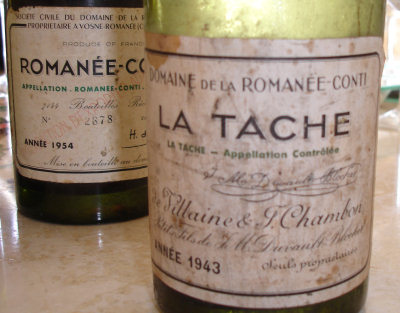
The second bottle came from a friend whom I appreciate, who is in the wine business, who asked : could you buy some of my wines as I am short of money. He proposed a La Tache 1960 with a low fill, saying : it should be good. The cork went out very easily, and the acidic smell did not hurt me.

We began with some crevettes, some amuse-bouche on a Puligny-Montrachet les Pucelles Domaine Leflaive 2000. Very drinkable, powerful, it is very pleasant, but I must say that it is more charming than elegant. No mistake, but no thrill. Then, on a plate, I had two huge belons oysters number 0000 (four times zero), which are enormous. What a taste! Amazing. And on a Besserat de Bellefon which is an average champagne, the oysters put the champagne on a trampoline. It gained some personality. The spéciales number two were nice, but not at the level of complexity of the belons.

Then I tried “violets”. I am 63 years old. It was the first time that I tried this animal. It is so ugly that the aesthetical disturbance prevented me to try it up to now. Jacques wanted to see my reaction on the violet plus champagne. It was fantastic.

We had some crude turbot, fantastic meat. The Puligny was not appropriate, too strong, but the wine of my dinner will be.

We had some sea fruits with complicated names (I have not my dictionary), like moules, palourdes, young calamars. The recipe should be changed, but it will match perfectly the Krug Clos du Mesnil that I intend to open.

Then we had two huge langoustines with foie gras, and the Royal Kebir 1945 was fantastic. This wine appears like a burnt wine. It makes you think of Port wine, of Maury, it is torrefied. But when you look behind the curtain, it is an emotional wine that you could take for a Chambertin. All in this wine is balanced. I felt liquorice in it. It is as if a Chambertin would have grown up in Lebanon. The more it developed, the more its complex structure was brilliant.

And I must say : it is strange, but it is a great wine.

We had then lamproie, which is one of the oldest fishes living in France, created some million years before our time. The meat tastes like earth, so I thought that La Tache 1960 would be great. But, I should never trust friends. I try to emphasize a wine which was largely over the hill. No hope despite some flashes.

I tried it on a cheese and at one moment I had some memories of a good La Tache.

But the final test was definitive : on a chocolate mousse, the Royal Kebir 1945 was magnificent, and the La Tache was like a lost sponge.

We have prepared the menu for a dinner to come in May (paying), and there will be in the menu three completely forbidden animals whose hunting is forbidden. Jacques, who is 73 years old, thinks that with me he can make mad things that he would never do with other people.