Thursday, November 19. 2009dégustation verticale de 56 millésimes de Clos de Tart de 2005 à 1887
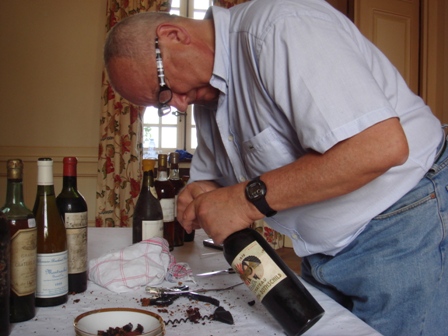
Some American collectors of old wines are grouped within the « wine committee » of the Commanderie of America of the “Confrérie des Chevaliers du Tastevin”. They have accumulated for years bottles of Clos de Tart, and they have asked Sylvain Pitiot to organise in the Clos a vertical tasting of 56 millesimes of Clos de Tart from 2005 up to 1887. Sylvain, who knows that I attend frequently great vertical tastings asked for my advices concerning the logistics of such an event, and I went to meet him some weeks ago to see how the event should be managed. Sylvain made me the honour to ask me to open all the old wines of this tasting. So, on the planned day I arrive at noon at Clos de Tart to open the wines. There are 57 bottles to open, which is just a little more than what I open when I organise a meeting of the “Academy for Ancient Wines”. Sylvain suggests that he opens by himself the youngest wines, which should represent no problem, but three times I had to help him to extract the bottom of rather young corks. Sylvain does not know the origins of the wines coming from USA, and does not know which travels and storage they have had. So, I have encountered very various situations. Some tops of corks smelled like earth, some smelled like dirty winding sheets, some other like humus. The 1923 is very strange because the level is extremely low, but when taking the capsule off, I see that it is dry and hard as rock. Where was it possible that evaporation appears? That is strange. And for one bottle I have seen a cork with a wording which I have never seen. It says : “bouchon de décantage”. So, decanting cork. What is the meaning of that? I have no idea. Before coming I had said that I would be happy to have a light snack while working on the corks. But I was invited to go to the lunch room of the vines workers, and the food was so opulent that I ate largely too much, my education telling me not to refuse what was proposed. Nobody would be able to imagine that in the restaurant of the workers of Clos de tart, it is a Tasmanian wine which was proposed to me !!!!! And it was good to drink. After my work, I went to Castel de Très Girard where I have a room, to have a small rest, and precisely at 4 pm sixteen people meet in the pressoir room of Clos de Tart. There are around Sylvain Pitiot Didier Mommessin and Patrice Noyelle who represent the family of the owners Clos de Tart, the group of the Americans, with a majority from New York, accompanied by Allen Meadows of Los Angeles, who spends four months per year in Burgundy and who is today one of the greatest connoisseurs of Burgundy wines in the world. Among the ones who will witness this unique event there are Jancis Robinson, Jeannie Cho Lee, the first woman Master of Wine from Asia whom I have met just one week ago, a journalist of the Revue du Vin de France, one of Bourgogne Aujourd’hui, Jacques Perrin a famous Swiss expert in wines and gastronomy, and some others. We will have eight flights of seven wines. In order that my analysis shows more interest, I have extremised my impressions, declaring uninteresting a wine which, if it were alone, would deserve my interest. But this exaggeration is necessary to show the fundamental tendencies on the long term of this fantastic wine. First flight. Clos de Tart 2005 : the smell is very vegetal. It is rich in alcohol; its finish is very powerful and dynamic. A wine with a very long future with pepper, spices and vegetal. Clos de Tart 2003 : its colour is the darkest of the flight. The smell is spicy, the taste is already more round. It is flattering, pleasant, round, with a brilliant finish. Shorter than the 2005, it is very pleasant and I like this subtle wine. Clos de Tart 2002 : the smell is straight, without great expression. More bitter, with less power and personality. The finish is rough. The wine is not very exciting (but it is by comparison). Clos de Tart 2001 : the smell is very pure. The taste is fresh, vernal. It is of an immense subtlety. The finish is not very long, but it is a great wine which evokes fennel, olive and spices. Clos de Tart 2000 : the smell is very sweet. The taste evokes red fruits, red current and raspberry. The finish is very fresh. It is original for a Clos de Tart, more agreeable than the 1998. Clos de Tart 1999 : its colour is precise. The smell is a little dusty. The body is a little rough, The finish is very fresh, smart, menthol like. It is the more refreshing. Very subtle it will become great. Clos de Tart 1998 : the smell is sweet. It is the more evolved of all. The feminine body shows teenage curves. It still lacks of an adult structure. It is a nice wine, a little rough. My ranking of this flight is 2001 – 2005 – 1999 – 2003, but I feel that if we wait a little the 2003 will jump above the others as it improves rapidly.
Second flight. Clos de Tart 1997 : the smell is rather floral and varied. The attack is very agreeable of fresh and red fruits. The finish is very smart. It is a nice surprise. Clos de Tart 1996 : the smell is precise, without very marked personality. The colour begins to tend towards orange (is it the very strong light of the room ?). It has a full taste, with a Burgundian bitterness on the finish. A nice solid wine, but without great panache. Its strong persistence is due to alcohol. It becomes more interesting when it evolves. Clos de Tart 1995 : the smell is discrete. But I feel the taste of the glass. It is a wine a little rough, with a bitter finish. Not very convincing wine. Clos de Tart 1993 : the slight nose of game is confirmed by the taste. The wine is deviated. It is a weak wine. Clos de Tart 1990 : by bad chance I have a glass which has modified the wine, and I can check when Sylvain and Jancis give me their glasses that the wine is very agreeable. My first impression cannot be significant, because this year should be great, as the two other glasses suggest. But I had no time to analyse with their glasses. Clos de Tart 1988 : it has a nice nose of an already mature wine. The colour has evolved towards orange. The taste is slender, but expressive of a more ancient wine. The finish has a nice roughness. It is objectively too evolved for its age. Clos de Tart 1987 : the smell is discrete. Alcohol appears in the taste. It is meaty, without true complexity. The finish is agreeable. But without more. I begin to classify so : 97, 96, 88, 87, 90. But the 96 progresses and my ranking becomes : 1996 – 1997 – 1990 – 1987 – 1988. This flight contains the more weak wines of all, with two only wines which deserve interest, knowing that 1990 should belong to the interesting ones if I had had a proper glass. Third flight. Clos de Tart 1986 : the smell is very beautiful, salty, Burgundian. The taste is agreeable. It is a balanced wine with a finish a little weak, but the general impression is very positive. A wine which is not very Clos de Tart but that I want to love. Clos de Tart 1985 : the smell is not very flattering. The taste is smart, fluid, with rather little substance. I like very much the finish of salt, pepper and vegetal. It is agreeable, not very profound and it is its finish which is very long and pleasant. Clos de Tart 1980 : the smell is very Burgundian. It is typically the Burgundy of a middle year whose I like the suggested expressivity. I like this wine. Clos de Tart 1979 : by the opening it had the smell the most spectacular, and it confirms, with a nose which is thundering and triumphant. It is a charming Burgundy. The alcohol appears a little too much and the sweetness too. The finish is nice, salty and of red fruit. It is a charming wine that I adore. Clos de Tart 1978 : nose very nice and subtle. It has a nice fruit in taste. The finish salty is a little too simple, but I like it and I tell myself that it will be difficult to classify the wines of this flight. Clos de Tart 1976 : the smell is neutral, the taste is agreeable without great speech. The wine is agreeable but I was expecting more. Clos de Tart 1975 : the smell is weak, tired. It is a wine without interest. I rank this flight so : 1979 – 1986 – 1985 – 1980 – 1976. Fourth flight. Clos de Tart 1974 : the smell is salty, discrete and alcoholic. The bitterness is obvious on a message rather limited. The finish is imprecise. Clos de Tart 1973 : the smell is very discrete, le taste is of red fruit, light raspberry. It is not very precise, but more warm-hearted than what I expected. Clos de Tart 1971 : the alcohol is very dominant in the smell. The wine is tired as the two first of this flight, but it has more fruits and an agreeable and long finish. I like its evolved Burgundy character. Clos de Tart 1970 : the nose is watery, the taste is watery, the wine is dead. Clos de Tart 1969 : the smell is agreeable and smart. It is fresh in taste. After the four first, this is wine ! I adore this wine with a finish menthol like. Clos de Tart 1967 : the smell is very Burgundian. It is more evolved than the 1969 but it is very nice too. It has a salty finish very exciting. Clos de Tart 1966 : it has a dirty tired colour. Its slight caramel taste disturbs the message. It is not uninteresting, but the « cooked » aspect disturbs me when others guests appreciate this wine. There are in this flight wines more tired than they should. I rank : 1969 – 1967 – 1971 – 1966. Fifth flight. The colours which were more and more orange and more and more light for the wines of the years 70 begin to become more dark red, which is a sign of concentration. Clos de Tart 1964 : the smell is a little game like and red fruits. The wine is adorable, because we begin to enter in the world of wines that I like. I appreciate this nice wine velvety. Clos de Tart 1962 : the smell is very agreeable. It is a nice wine which is a good surprise and pleasant. I am asked to open a new 1955 and I take this opportunity to show how I proceed to open old wines. By a good chance the cork went out complete, as I have done for nearly all the corks of the old wines. Clos de Tart 1961 : nose very smart. It is a very nice wine, very racy. It is a very great wine but the rather old fashioned style of the 1969 pleases me even more. It is a very great wine with superb nose. Clos de Tart 1960 : the smell which is evolved is not pure. The finish is deviated, tending towards game. Clos de Tart 1959 : we will taste two bottles as one of them is announced Vieilles Vignes (VV). Le VV has a very nice smell. I love it, even if its alcohol shows. The second Clos de Tart 1959 shows its freshness, with a more beautiful colour. The structure of the VV is obviously dominant, and the freshness of the second is great. Clos de Tart 1957 : the smell had pleased me by the opening some hours ago. It is now nice but less impressive. The alcohol comes shadowing the fruit. It is sad. Clos de Tart 1955 : the wine of Van der Meullen a Belgian negociant with a sulfurous reputation is in a bottle of red glass which makes impossible to see the colour through. In the glass, it is a scandalous imposture. When one compares with the second Clos de Tart 1955 that I have just opened, the difference of colours is exactly like a Port wine compared with a Beaujolais. The first has a fortified taste, it is cheating. The second has a nose a little burnt. It is agreeable even if it is a little too evolved. The ranking of this flight is : 1961 – 1964 – 1962 – 1959. Sixth flight. Clos de Tart 1954 : the smell salty is very Burgundian. The taste agreeable is of raspberry and the finish is salty. It is a rather nice wine, above what I was expecting. Clos de Tart 1953 : The alcohol is prominent in the smell. The taste is very flattering. It is a wine well expanded. The finish works very well. It is a nice wine very smart. I adore it. Clos de Tart 1952, caves Nicolas : the smell is fine and smart. The wine is very smart. It is not very Clos de Tart, but very agreeable, with a finish agreeable too. A good wine a little out of norm. Clos de Tart 1951, caves Nicolas : the smell is mushrooms and burnt. The wine is deviated and tired. It is dead. Clos de Tart 1950 has the more original, strange and unknown label as it indicates for which Belgian notary a negociant Couvreur has bottled it : the smell is very agreeable ; the smartness is remarkable. It is a nice wine, it is true wine. It performs splendidly. Clos de Tart 1949, bottling Van der Meullen : the smell is extraordinary. It is a little sweet, even sugared and its finish is a little short, but it is fine. It is a very great wine. Clos de Tart 1948 : it is a little tired, its finish is displeasing, even if the wine is not to neglect. By instinct I taste again the 2005 and the gustative continuity of the 2005 with the 53, 50 and 49 is spectacular. The ranking has evolved due to the considerable expansion and improvement of the 1953 and I rank : 1953 – 1950 – 1949 – 1954 – 1952. Seventh flight. Clos de Tart 1947 : the smell is very Burgundian with this delicious bitterness salty. The taste is salty. It lacks a little complexity, despite the power that I find too in the finish. But the wine improves a lot and becomes very very great. Clos de Tart 1945 : the colour is more pretty that the one of the 1947. The smell is very smart and lively. It is a very great wine lively and accomplished. I put in my notes : « wine immense » and expanded. Clos de Tart 1943 : the smell is of raspberry. The taste is very red fruit. It is lively and rich, with a finish of red fruits. A very nice wine which never ends in taste and with a nice colour. Clos de Tart 1937 of Bouchard Aîné & Fils : alcohol appears in the smell. The taste is brilliant. It is a rich wine and nice which impresses me as it is superior to its year. Clos de Tart 1934 whose collerette (label) of year is in a red round: its nose is not so agreeable. The taste is nice even if tiredness can be felt. It is the more tired of this flight for the moment. Clos de Tart 1929 of F. Chauvenet : its colour is magnificent. It is very compared with the 1928 which is troubled. The taste is nice, precise. It is has wine of pure definition. A wine neat, extraordinary. Clos de Tart 1928 of Van der Meullen : it is corked, troubled, dead. The ranking has evolved due to the spectacular evolution of the 1947. It is so : 1947 – 1929 – 1945 – 1937 – 1943. It is by far the greatest flight, even with the bad 1928. Eighth flight. Clos de Tart 1923 of Chauvenet : the colour is troubled, the smell medicinal. The taste is acceptable, maderised. Clos de Tart 1921 Van der Meullen : the colour is dark, the smell is medicinal, twisted. The taste is agreeable but the wine is burnt. Clos de Tart 1916 : the colour is nice and clear, the smell is very great. The wine is fresh, limpid, clear and pure. A very great wine with a finish of great distinction. Clos de Tart 1915 : the smell is very raffiné. The colour is very nice. A wine immense, of an incredible balance, of a mad youth. Before the opening of the wines, by bravado, I had said that the winner of this tasting would be 1915. We are not far from that as the wine becomes more and more young and seducing. Allen Meadows made me a pleasure by declaring that he had the same idea when coming for this tasting. Clos de Tart 1914 Faiveley in 37,5 cl : the smell shows alcohol. The colour is nice. The wine is not perfect but it drinks well. The finish is not very precise. Interesting, this wine is not sufficient. Another Clos de Tart 1914 in 37,5 cl Jules Régnier is corked. Clos de Tart 1900 Nicolas bottling : the colour is nice and the smell is not perfect but acceptable. It does not have the panache that a 1900 should have but it awakens progressively. Clos de Tart 1887 from Bouchard Père & Fils : the colour is young, more structured than the one of the other wines of this flight. The smell is very subtle, nearly too delicate for a Clos de Tart. The taste of the only pré-phylloxérique wine of this tasting is marvellous. It is a trip to the unknown. A magnificent wine of pleasure. My ranking is : 1915 – 1916 – 1887 – 1900. This tasting is exemplar as we have been able to follow a wine along history with 56 stops on the path of 118 years. Nothing would be able to teach a wine on a deeper way. The period of the 70ies and the 80ies has been marked by wines which were not at the level that they should have. Without wanting to flatter Sylvain Pitiot it is clear that since his arrival at the head of this Clos, progresses have been enormous. And I have been extremely pleased to see that 2005 is in a direct continuity with the lovely wines of the 50ies. What is remarkable is that Clos de Tart is almost always great in the great years. 1915, 1929, 1945, 1947, 1961 were years for which Clos de Tart has marvelously performed. This proves that this terroir gives longevity to its wines. The wines coming from Van der Meullen bottling were shocking fakes except one or two. The logistics of the tasting was perfect. I have been able to compare with the opening of wines with the rules of Bipin Desai. According to Bipin, wines are opened at the last minute, are strongly quickly decanted and poured. With my method, wines were not decanted and breathed for 4 to 8 hours. It is clear that Bipin’s method gives more freshness to the wines. My method makes appear alcohol in weak wines more that it should. But for great wines, the expansion of the wines is greater. And the pleasure for great wines is incomparable. The defects appear greater with my method. But the stars shine more. Apparently Sylvain was extremely pleased that it was done this way. Thanks to the American group, we have had a unique opportunity to explore a Domaine so extensively. Thank you Sylvain to have made it possible. We had a dinner afterwards, and to thank the American group, I opened a 1927 Yquem extremely rare which was delicious, and a Bourbon of the 19th century, for which I fell in love, that comes from the cellar of Duke of Windsor from whom I have acquired in auction a part of its Parisian cellar. This magnificent travel in the history of Clos de Tart wines is a moment that I will never forget. |
Wine DinnersIndexConsulter l'intégralité des bulletins dans les Archives de 6 ans de dîners
CatégoriesLangueQuicksearch |